4/13/2025
“The Underground Life of Jesus Christ, Superstar”
(originally published in Final Touchstones, 2023)
by Linda Romanowski
Every Easter, I think of the underground life of Jesus Christ, Superstar. That foul piece of supposed music will have no place in this house! my father roared.
The Superstar concept album debuted in 1970, and in our neck of the woods, the heavily Catholic Northwest section of Philadelphia, it was nothing short of heresy. Heavily Catholic meant Mass every Sunday with your family. Heavily Catholic meant you went to confession at least once a month. Heavily Catholic meant you graduated from your solidly catholic grade school, then graduated from your local solidly catholic high school. Some of us continued our solidly catholic education when we graduated from a solidly catholic college. What else could one do but return to your solidly catholic church to be married?
My father became livid as he observed the priests from the pulpit, the articles in the Catholic Standard and Times newspaper, and the nuns at my high school alma mater, in holy fits over this blasphemous telling of the final days of Jesus.
Dad was appalled at what he was hearing, this ceaseless, gossipy pontification. We knew he had not heard a single note of this libretto. We knew better than to protest over his fire and brimstone rant.
So, my siblings and I did the next best thing. We went underground with it.
***
Luckily (or perhaps it was shrewdness on the part of the producers), the album was that wonderful darkish brown color, which lent itself, no pun intended, to an infinite number of hiding places. One day, Dad came home from work earlier than expected; Mom was having a conniption as the album was in full view on the kitchen counter. We learned early in life not to make any sudden movements when we were doing something degenerative when he was around, so as not to call attention to one’s self. We calmly passed the album through the faux window into the dining room as he entered the kitchen, our contraband out of sight. We reversed our tactic when he re-entered the dining room.
Keep in mind, this behavior was not unique to our neighborhood alone, recall we lived in a heavily Catholic area. We became self-groomed Masters of Subterfuge.
***
Fast forward to many years later, when our local Public TV station aired a production of Superstar. My Dad got wind of it and decided to view the program. Two seconds after it was over, he called me. I was white knuckled as I picked up the phone, fully expecting to hear for the zillionth time, that all of us should be excommunicated for having anything to do with/taking any enjoyment from, the performance.
But that’s not what happened. He expressed total amazement, stating how great the music was, and that now, he “got the message.” When I was too flabbergasted to respond, he thought I had fainted.
Linda, are you still there? he asked. When my heart restarted itself, I answered, Yes, Dad, I’m here.
He wanted to know about Andrew Lloyd Webber and Tim Rice, the duo behind this rock opera. He remarked:
That one song, “I Don’t Know How to Love Him.” That’s beautiful. I don’t remember ever hearing it before.
Sensing his awestruck mood, I interjected, It makes Mary Magdalen and Jesus human beings, doesn’t it?
After a moment of silence, he answered, Yes, it does.
Then, he sighed, the closest behavior I would get to an apology. I reminded him of what he once told me long ago, that good music is good music, no matter when it’s written, no matter what the motivation behind it.
I knew what would come next because Dad was Dad.
He asked, Okay, where did you kids hide the album?
Silent tears of laughter rolled down my face as I twisted the phone cord.
You’re not gonna tell me, are you?
Nope! I answered, And it’s too late at night for you to come after me!
He exploded with laughter. Jesus most assuredly rose from the dead again after hearing this exchange.
***
The most interesting thing about Superstar was how my thoughts about Holy Week and Jesus and His followers changed significantly. While the production clearly places Judas on a blasphemous pedestal from the viewpoint of the Church’s teachings, what it did for so many of us was to shift the focus to the humanity of Jesus and the people around him. Some of the songs are so strong in their struggles, the verbiage, outstanding. The most powerful line in all of Rock Music for me is the line that Jesus sings in the Garden of Gethsemane, “First, I was inspired, now I’m sad and tired.” There have been times in my Life when I have truly felt that way. There was very little emphasis or explanation about this aspect of Jesus and his disciples during our Catholic formative years. This portrayal transformed me like no other music did.
What upset us more than anything else, was that our parents just took what was told to them on blind faith and did not take the time to listen to the music for their sake or for ours. As we saw it, there’s Jesus and Judas and Mary and Pilate in all of us; they will always be in all of us until we leave this earth. By not taking the time to give us a chance, they missed the point completely.
***
The last movement of Superstar, John’s Psalm, is very brief, subdued, without singing. I have played this piece many, many times. For all its soothing, diametrically opposed sound, it conjures a permanent image for me of what happened immediately after Jesus died. My mind sees Him being removed from the cross, placed in His Mother’s arms, then, placed in the tomb, without the fanfare and the adoring crowds. I think of Mary, Jesus’ Mother, who started on her journey alone, pregnant at fifteen, then with Joseph, then losing Joseph (who died before Jesus did), then losing Jesus, and coming full circle, alone once more.
I cannot imagine greater heartbreak.
12/22/2024
“Christmas Reprise”
by Linda Romanowski
Every Christmas, I hear my grandmother’s voice.
My maternal grandmother, Sebastiana Arcidiacono, could sing like an angel. When she attended Mass at her Italian parish, St. Nicholas of Tolentine Church on Watkins Street, no one needed to wonder who was singing.
The only Christmas carol I remember her singing was “Silent Night”. Or, rather, “Sire-ly Night”. Her Italian accent made it impossible for her to pronounce many English words correctly. So, “Sire-ly Night” was “Silent Night”.
When I was a child, I used to beg her to sing it. I’d do it on purpose. Not because I wanted to make fun of her, but because her version of the song, with English and Italian words blended together, was so endearing. The sincerity of her feeling, the music, and what it represented, compensated for her interpretation. Her soprano voice would fill the tiny kitchen of her South Philadelphia home, the home I so dearly loved on Fernon Street, creating a Nativity of Sound. No one could ever sing “Silent Night” the way she could.
********************
It was the first Christmas she was gone that it all came back to me. There was that quiet moment, that ethereal pause between wakefulness and sleep, when I heard her sing. That was in 1974. I didn’t tell anyone about it for years. I have experienced this moment every Christmas since then.
********************
I haven’t heard her sing yet this year, but there is still time. Time when I will really need to hear her voice of comfort again. To tell me she is still with me. Sleeping in Heavenly Peace. Sleep in Heavenly Peace, Grandmom, sleep in Heavenly Peace. Missing you still. Buon Natale. Love Leenda, forever and ever.
11/28/2024
“Pulp Slicktion”
by Linda Romanowski
That last Thanksgiving, Grandpop Archie and I sought out a new food adventure, making pumpkin pie from scratch.
This was an enigma for him, strange as it sounds. Grandpop was an outstanding cook, his range of expertise with vegetables was peerless, yet this gourd had never met his acquaintance.
So that Saturday morning, when he saw me lugging a misshapen, Cinderella reject through our front door, his curiosity got the better of him. He announced, rolling up his sleeves and grinning, that he would be happy to work with me in gutting the pumpkin.
He was seated at the kitchen table, walking cane perched on the end of the chair. I arranged the cutlery before him. He inspected the knives and the other accessories needed to begin our task.
This pumpkin was an unwieldy, bottom heavy beast. Grandpop quickly realized this, steadying it as I cut through what would be his first assignment. Slowly, we worked together. I stopped midway and turned the other side of the pumpkin toward me to complete the cutting. As I did so, I realized much of the weight came from the juice and the seeds inside, so I proceeded with caution.
That’s when my efforts took a nosedive. I lost control of the knife, and the pumpkin went flying off the table. It smacked against the kitchen island, ricocheted under the table, split into three misshapen sections.
Before I could drop to the floor to survey the damage, grandpop moaned, Leenda, I’m slipping!!! Parts of the pumpkin slammed against his shoes, juice and seeds waxed around them, his reflex to extricate himself slid him into pulpy quicksand.
We were in a deadlocked struggle. His cane teetered and plunked to the floor, out of my immediate reach. Grandpop’s chair was moving against our will. No one else was home; I could see where this was leading. My only option was to flatten myself along the floor; in doing so, I stretched with all my might for the cane. I don’t know how I managed to maneuver it against the kitchen wall while I spread myself across the floor, grabbing grandpop’s shoes, telling him to push back to the wall while I held on.
Suddenly, he started to laugh; this variable added a new pitch to my rescue plan. Dear God, help me out of this, I prayed. I pushed him and the chair with all my might, moving him out of danger. He was still laughing. When I stood up, I was covered with the squashed squash. The seeds beaded themselves like a necklace down the front of my sweatshirt. The tears in my eyes weren’t only from laughter and relief but from an unspoken realization that we might never have a chance to do this again.
Grandpop’s observation, still with a grin on his face was, See that, Leenda, we’re never too old to learn new t’ings!
***
I don’t remember how that pumpkin pie turned out, or how many seeds I continued to find for weeks afterwards, but that narrow escape, and those words of wisdom have never been truer for me than it was for Cinderella when her pumpkin turned into her enchanted carriage.
Pulp Slicktion was originally published in Ovunque Siamo, an on-line publication, on November 1, 2021.
3/3/2024
“First Job/Final Season”
by Ken Romanowski
In June of 1970, I was 18 and recently graduated from Cardinal Dougherty High School in Philadelphia. I began to search local newspapers for summer jobs, and soon regretted my delay in starting. My job experiences included mowing lawns, shoveling snow, and transporting groceries for tips. I also returned glass bottles discarded along the road to the neighborhood A & P grocery store for pennies per item. I found myself in the traditional maze of needing experience to secure a real job, and unable to acquire experience.
June passed without a nibble, but on July 2, I found a tiny advertisement in the classified section of the daily Philadelphia Inquirer: “Men, over 18, Vendors, Connie Mack Stadium.”1 Applicants were to apply ready for work that day at the concession office at 21st and Somerset Streets.2
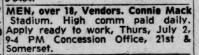
I felt uneasy. I did not like the idea of traveling at night on a bus by myself to an area where safety is a concern. On the other hand, I’d be working at a big-league ballpark, the home of the Philadelphia Phillies! Additionally, the job didn’t require prior experience…a definite plus given my circumstances.
Baseball was a passion in our family. My Dad took me to my first game at Connie Mack Stadium in the late 1950s. Robin Roberts and the remaining Whiz Kids of 1950 soon became favorites. I had the distinct pleasure of seeing the great Willie Mays of the San Francisco Giants play against us. The Phillies typically did not play well at that time, although every few years their performance improved.
The stadium, originally known as Shibe Park, was built in 1909.3 Aside from the finely manicured, bright green grass field, it was now showing its age. Much of the stadium appeared shabby and in need of upgrading. I still recall a single light bulb hanging from a long wire attached to the underside of the grandstand roof. The steps were steep, yet the fans were reasonably close to the action on the field.

Postcard c1911
The Library Company of Philadelphia
https://www.librarycompany.org/
While I was contemplating the pros and cons of this job opportunity, my Dad said to me, “What choice do you have? You don’t have any experience.” Dad’s words of wisdom won out, and I answered the ad by making a visit to the stadium that morning. After a preliminary meeting, the fledgling vendors were sent to a City of Philadelphia health facility, where we received a chest X-ray to test for tuberculosis.
Apparently, I passed, and as the advertisement indicated, we were now expected to work. My first day on the job was an endurance test. The Phillies were playing a twi-night double header against the New York Mets. The first game began at 6:05 PM. I was given the task of selling trays of Coke and Seven Up by climbing the concrete steps of the old stadium. The weather was warm, though not oppressive. As a novice “hawker”, I did not move with the grace and efficiency of those who were experienced, and by the end of the day, I was exhausted.
The sales process was simple. Vendors brought their own cash to the stadium to make change. They also purchased a tray of drinks from the dispensing staff located behind the stands. This steel tray was lined with paper cups filled with the appropriate drink. A stainless-steel device was lowered over the tray, shrink wrapping the top of each cup.
When the tray sold out, we would buy another if we were confident to sell it by the end of the game. Unsold drinks lost revenue, so it was best to avoid them as much as possible. For this reason, many vendors ceased purchasing new trays by the seventh inning. On the other hand, on particularly hot days, vendors would buy a new tray even before the first one was sold out. We wanted to be sure we had enough product to sell to our thirsty customers. At the end of the game, our profit was in our coin belt, along with the change from the beginning of game.
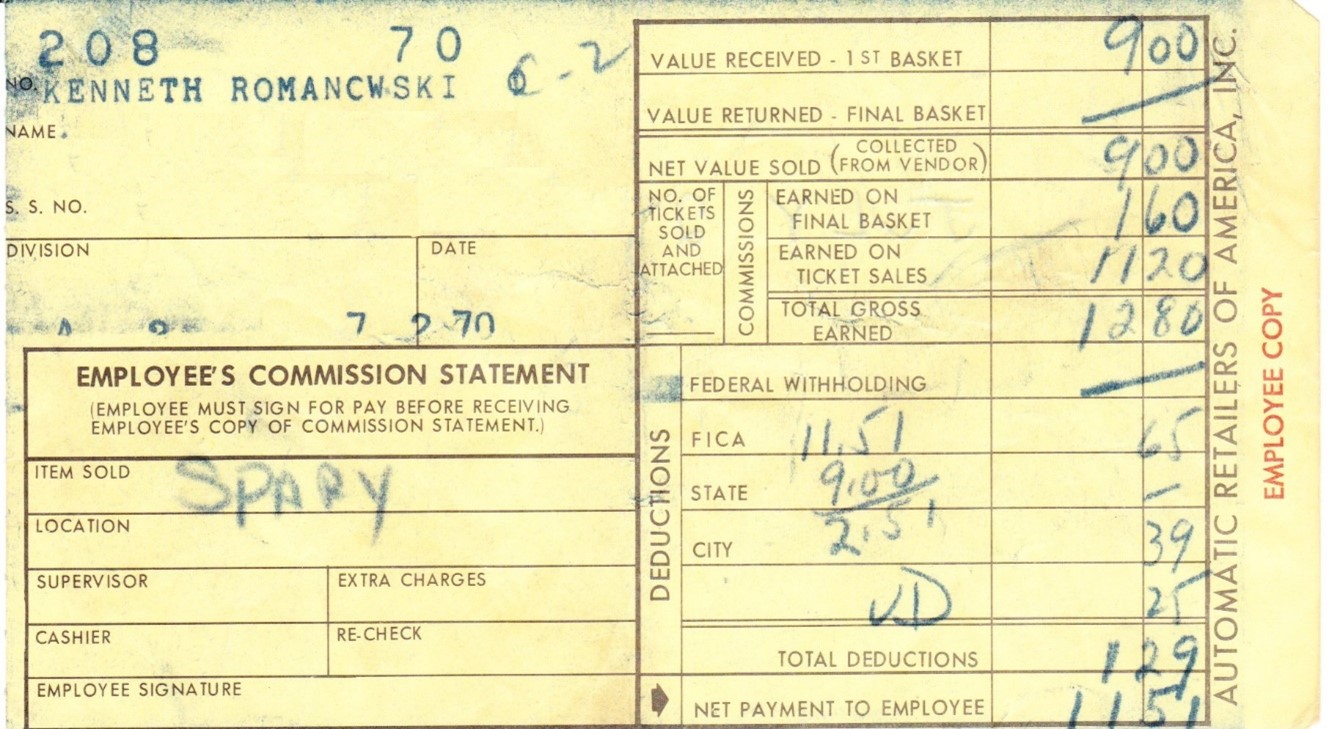
Our commission for each sale was 19%. I earned $11.51 on my first day for about five hours of work. The minimum wage that year was $1.00 per hour (and $1.60 in 1971),4 so for someone without job experience, the day was productive. As the summer progressed, I learned a few short cuts and sales techniques to increase my average to $6.00 per hour during a 2-hour day.
My First Paystub, July 2, 1970
My new experience became an adventure. As a baseball fan, I began to realize how fortunate I was to be there with free admission, plus commission! I could even move within my assigned area for a better view of the action on the field. I soon began to arrive early and watch batting practice. I obtained a few autographs for the young lady I was dating, including one from her favorite, Johnny Bench. I also learned the importance of tipping the staff who supplied our drink trays. One day, I inadvertently flipped my tray and spilled a large portion of product. Embarrassed and concerned that the day would be a financial disaster, I went back to the dispensary and told the man behind the counter my tale of woe. He smiled, prepared a new tray, and told me to be more careful next time. Lesson learned!
Several moments at the ballpark that summer are memorable. An Old-Timers Game on July 25 showcased retired players of the Phillies and a team of veterans from the old Philadelphia Athletics organization (the “A’s”). The A’s relocated to Kansas City back in 1955. Although there were future Hall of Famers on both teams, one player inducted back in 19475 stood out. I was fortunate to see him tip his cap to the crowd. His name was Lefty Grove. When the announcer called his name as part of the A’s lineup, long, thunderous applause followed. Even though I didn’t know much about him at the time, I knew his name, and realized that one of the greatest pitchers of all-time was on the field at that moment. I was very moved.
Later that summer, I met my favorite Phillie of all time, Johnny Callison. The Phillies traded him in the off season to the Chicago Cubs after 10 seasons. The Cubs disembarked from their bus outside the stadium and entered through the rotunda at the entrance on 21st Street. I remember approaching him near that rotunda and asking for his autograph. He didn’t seem pleased, but obligingly signed anyway. It was strange to see him in a non-Phillies uniform.
Also that summer, one of my co-workers introduced me to the titan of Philadelphia vendors, Charlie Frank. Charlie began his vending career in 1948, playing at Connie Mack Stadium, Franklin Field, and the Palestra. Known for selling hot dogs, his “Daaagie” chant and its variations made him memorable. While attending a game a few years earlier, I first heard his yell and found it rather peculiar. Even so, I bought a hot dog from him! He was onto something with his distinctive call. Charlie was so popular that the University of Pennsylvania honored him with a PhD (Purveyor of Hot Dogs).6
Prior to the start of our work session, vendors gathered in a changing room under the grandstands. It was here we received our product assignments, purchased our drink tray, donned our change aprons, and made sure we were ready to go. On one occasion, one of the vendors, a somewhat tall and husky man in his forties, made the following announcement to a group of us who were present: “If anyone comes into my territory, I’m going to slit their throats!” The room was suddenly quiet. I don’t know what prompted this outburst, but he made his point, and I thought nothing more of it. It was not in my nature to infringe on someone’s territory.
A few days later, I was assigned a location on the lower level of the first base side of the field. I began my shift by canvasing the center of my territory, gradually working my way toward the stands behind home plate, but still within my assigned area. Fans here were protected from the field by a cyclone fence that stretched upward to the top of the press box, but below the upper deck. The barrier was small by today’s standards, but large enough to protect the backdrop of home plate. A customer to my left, two rows above me motioned for a purchase. The stands were not crowded in that area, so I easily worked my way toward the sale. I was about a third of the way through the purchase when Mr. Slit-Your-Throat suddenly appeared from the right and began to take over the transaction and the commission. I don’t remember his exact words, but he made it clear he was taking this sale, even though his territory was on the third base side of home plate. I couldn’t believe what was happening. At first, I froze. I then backed away. I was not going to confront this guy, especially given his previous proclamation. Another vendor, much older and shorter than me, saw what was happening and told me that I should not let him get away with this. It was easy for him to say that, especially since I would be the one to confront him! Since the older vendor acknowledged what happened, I know with certainty that I did not infringe on Slit-Your-Throat’s territory.
I have no recollection of seeing the bully again. Perhaps someone reported him and he lost his job.
On the whole, my experience at Connie Mack Stadium was a positive one. When my classes at Temple University began in September, my vending career was over. I missed the remainder of the season, including the Stadium’s final game on October 1, with all of the mayhem and destruction that followed. The Phillies moved to Veteran’s Stadium the following year, and by then I found summer employment elsewhere. That same year, 1971, the remains of Connie Mack Stadium suffered a major fire. The structure was demolished a few years later,7 but my memories remain.
1Bibliography
“July 2, 1970 (Page 35 of 44).” 1970.Philadelphia Inquirer (1969-), Jul 02, 35. https://www.proquest.com/historical-newspapers/july-2-1970-page-35-44/docview/1841920961/se-2.
2 Philadelphia Inquirer, July 2, 1970, 35.
3 Shibe Park/Connie Mack Stadium (Philadelphia) – Society for American Baseball Research (sabr.org)
4 United States Department of Labor, History of Federal Minimum Wage Rates Under the Fair Labor Standards Act, 1938 – 2009
5 Lefty Grove – Society for American Baseball Research (sabr.org)
6 A hot dog vendor’s life in the dog days | Frank’s Place
By Frank Fitzpatrick, columnist of The Philadelphia Inquirer, August 25, 2017
9/7/2023
“Sweet or Savory:
In Search of Dutch Pancakes”
By Ken Romanowski
Our initial stay in Amsterdam was brief. We flew on a Monday evening from Philadelphia to Schiphol Airport, arriving around 7:40 AM Tuesday morning. We were then transported several kilometers away to a hotel near the train station where we’d depart the following day for Germany. After spending a week in Germany, we returned to begin a deeper exploration of Amsterdam.
On our first encounter of this beautiful city of canals, we noticed a number of pancake restaurants and wondered if gluten-free options were available. After a review of local websites, we discovered several offering traditional and gluten-free options. We opted for one that was part of a small chain, Pancakes Amsterdam. The restaurant was a short distance from our hotel, so we thought it would be a good choice.
Although the restaurant was only a few blocks away, our journey was daunting. We’d been forewarned about bicycles by our driver from the airport. Trying to get to the restaurant, we were challenged by bicycles from every direction that appeared out of nowhere. Several of the bike paths along the way were clearly delineated, however, road construction created temporary alternates. It was difficult to determine which path was for pedestrians and which paths were for cyclists.
We continued our expedition, ever mindful of all the modes of transportation converging in this area. We were in clear view of Amsterdam’s Central Station, a magnificent 19th Century structure that could pass as a fine art museum. Arguably every mode of land and sea transportation passed this landmark: ships, canal boats, international rail, metros, trams, buses, and oh yes, bicycles, as if to pay it homage.
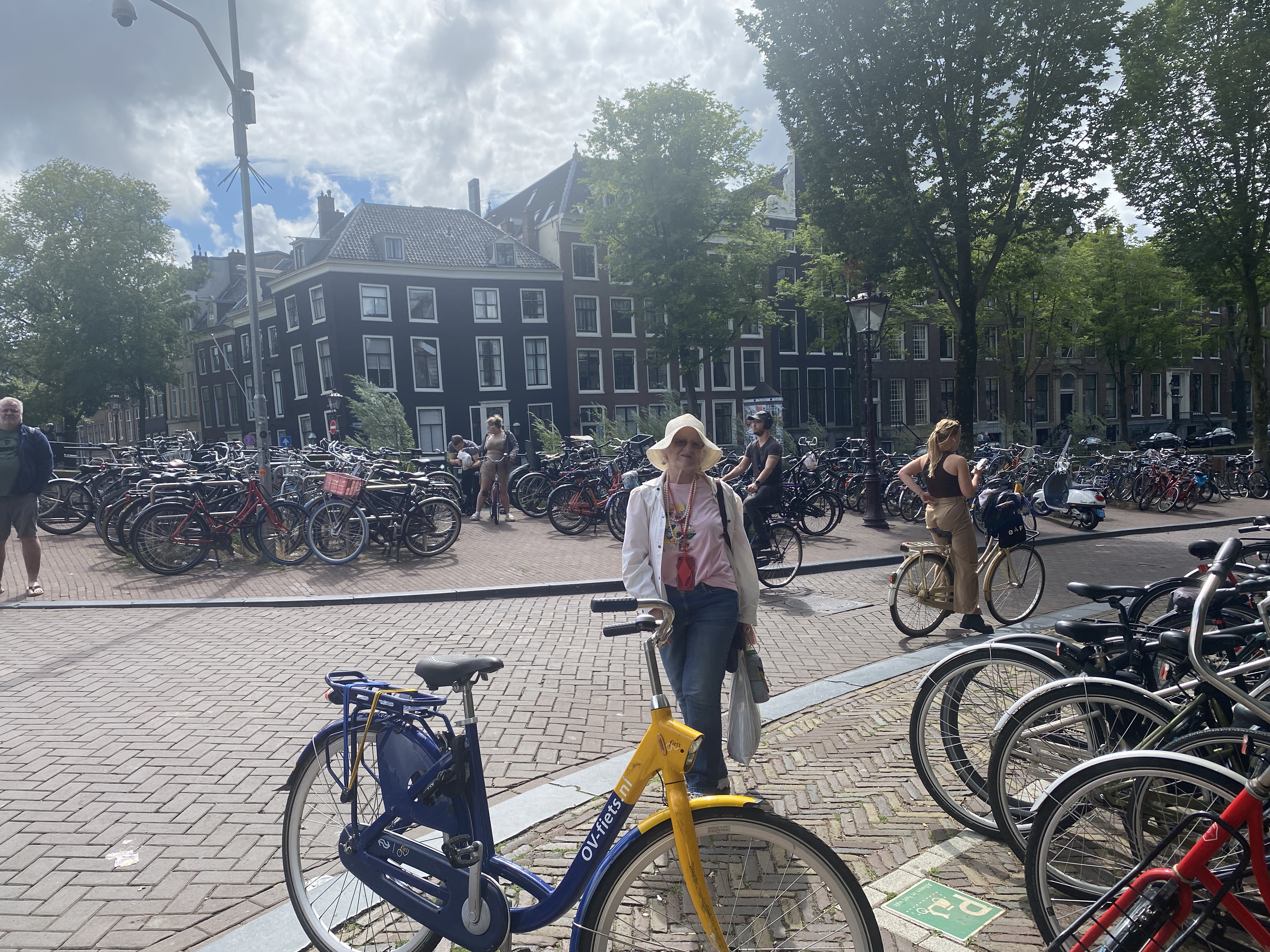
At one point, while a dissonant beeper marked the safe crossing seconds at a pedestrian crossing, we felt a sense of accomplishment crossing the paths of trams and autos. Our delight turned to trepidation when we realized that there was still another leg of our walkway: a wide bike path, complete with speeding cyclists riding two and three-wheeled vehicles of aggression.
Now, firmly on the other side of the street, we turned to the right and weaved our way across each successive street and sidewalk. We proceeded cautiously as we encountered more speedy cyclists assuming the right-of-way. We could not be far from our journey’s end, yet each new street failed to reveal our destination. Undaunted, we pushed forward until the restaurant was in sight. We were overjoyed as we joined the queue of diners.
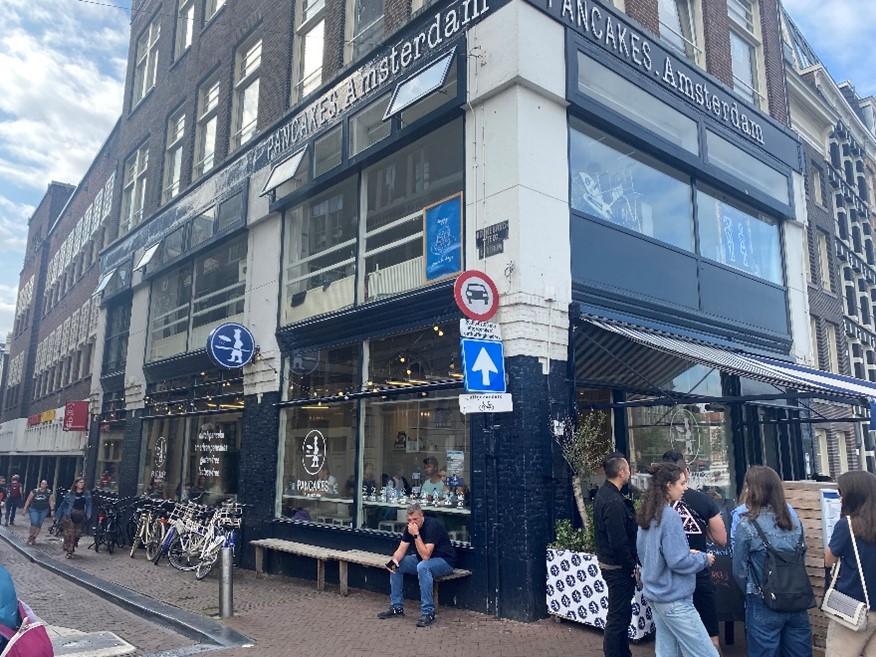
When the maitre’d asked how many were in our group, we knew that our wait would be short. We’d learned over the years that parties of two are often seated faster than larger groups, and our theory was again proven true. I confirmed that indeed, Pancakes Amsterdam offered gluten-free pancakes. Additionally, every pancake option was available gluten-free. I smiled and told him he was about to send me to heaven. He gave me a strange look, but that was ok. I just knew that something special was about to take place.
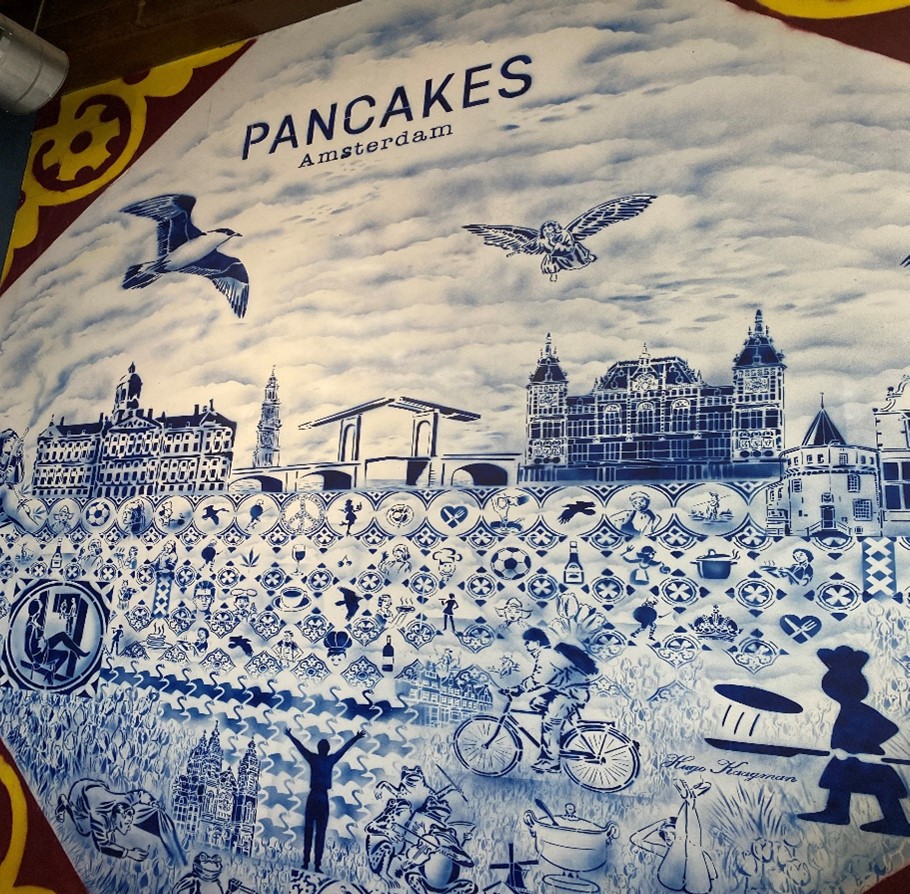
We sat at a small table near the top of a stairway. The area was cramped but manageable. Our young and helpful waitress pulled out two paper menus, and sure enough, gluten-free pancakes were listed. We even had a choice of sweet or savory pancakes! Since sweet pancakes were the norm back home, we decided to go savory.
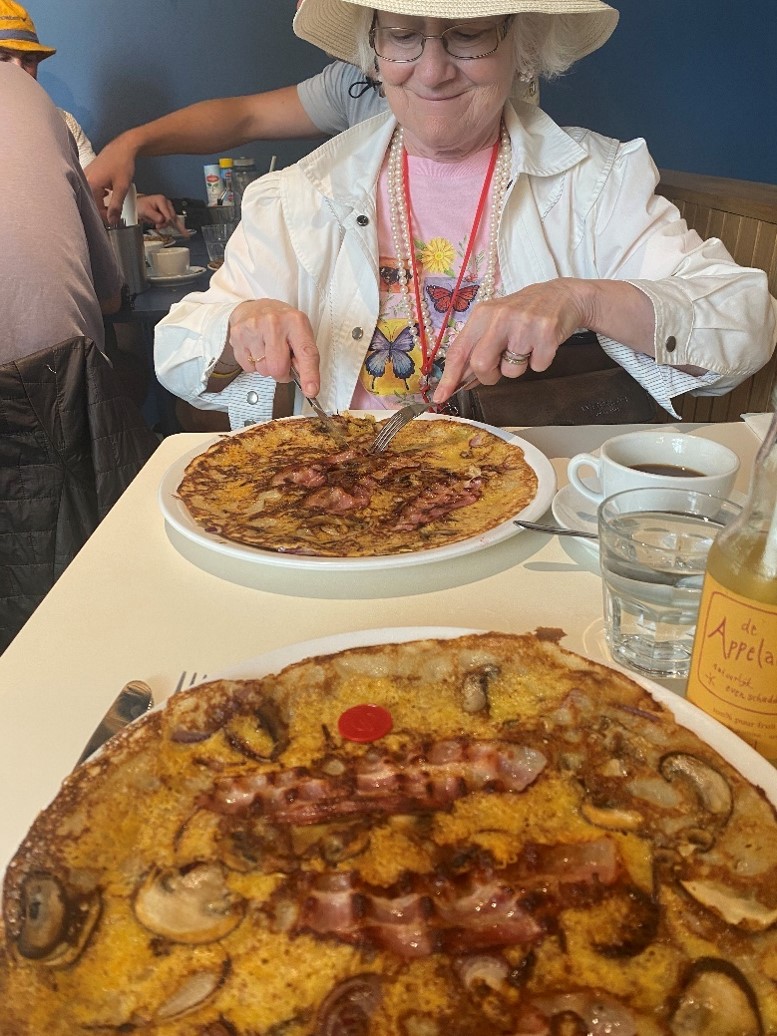
Dutch pancakes are light, thin, wide, and tasty. Our version imbedded bacon, onion, mushrooms, and cheese. We selected Dutch coffee, which is a combination of regular coffee, whipped cream, and a shot of eggnog. I also opted for apple juice, made from apples grown at a local farm.
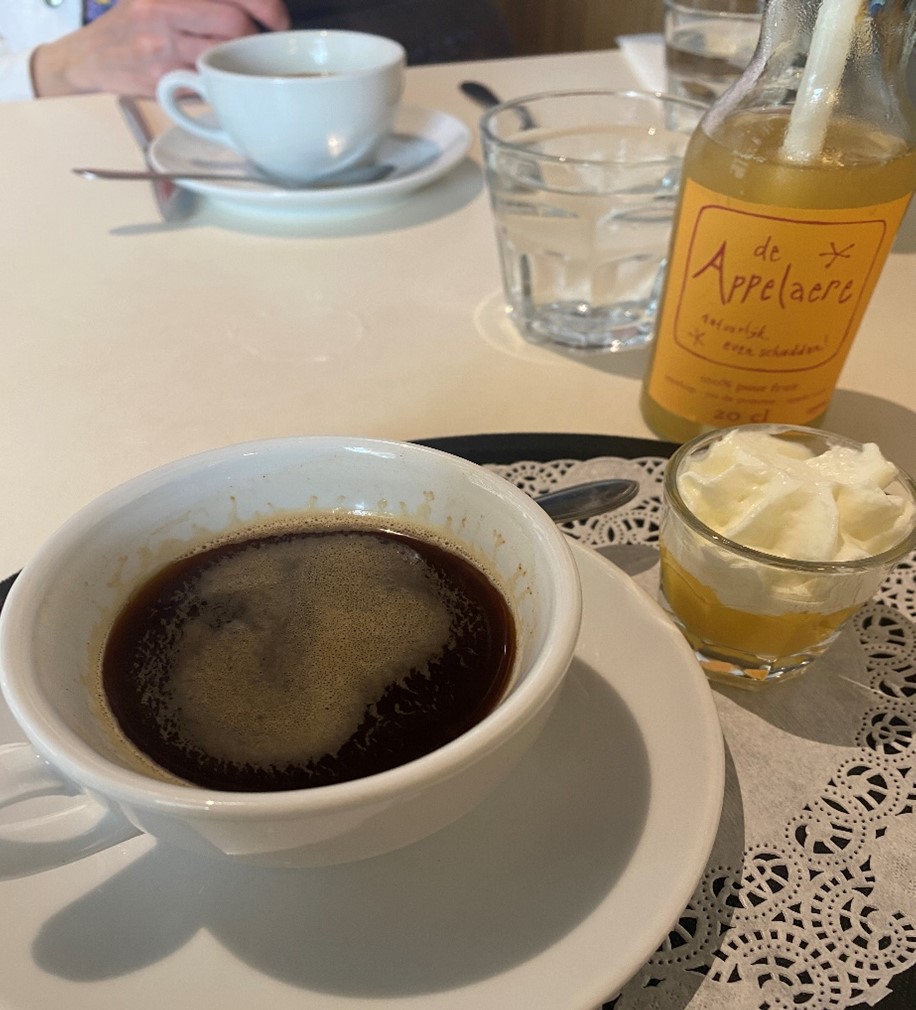
Indeed, my prediction of having a heavenly meal came true, and I felt giddy as my ties to mother earth were loosened with each bite. Our experience was not only great, but it was also memorable and worth dodging those bicycles.
12/17/2022
“Santa Matt”
by Linda M. Romanowski
One Christmas Season, the daycare center my daughter Eve attended had a crisis when their Santa Claus couldn’t perform for the annual Christmas show.
They were down to the wire; Santa’s unexpected illness took the staff by surprise. To their dismay, they couldn’t find anyone who could come to the rescue on such short notice.
When I found out, I contacted my father-in-law, Matthew (Matt) Romanowski, immediately. Without hesitation, he responded, “Of course, I’ll do it!!!”
Beyond the obvious reasons for Matthew being an excellent choice, he lived around the corner from the center. The other advantage was that he knew all of Eve’s friends (who were a group of four-year-olds) and several of the other little ones as well.
During that time, one of Eve’s classmates, a charming little boy named Luke, was experiencing hard times. His father had recently and unexpectedly walked out on him and his mother, and the effect was obvious to the point of near alarm for all of us. Maria, his mother, a truly sweet woman, tried her best to keep it together. We all became more friendly as the season approached. Maria mentioned her concern for her son, particularly his self-esteem, as he thought he was the cause of his parents’ separation.
Matthew was also aware of the situation and used it to full advantage at the end of the children’s program. He singled out Luke, as he distributed Christmas taffies, and said to him,
“You have been a very good boy. I am so proud of you”.
Luke’s psyche lit up like the Christmas tree in the Philadelphia City Hall square. Maria turned her head to keep him from seeing her cry.
It couldn’t get any better than this. Santa Matt had saved Luke’s Christmas. How we all miss you, Santa Matt!
Names in essay have been changed to maintain anonymity.
11/27/2022
“Sears Had Everything“
by Linda M. Romanowski
My reading awareness began when I was four years old. As years passed, I noticed there were other types of print material besides the children’s fairy tales my mother would read to me before bedtime. The Philadelphia Bulletin first captured my curiosity, folded tight as a backpack with a wet faded smell of fresh-off-the-press newsprint. Dad and Grandpop didn’t seem to mind the traces the ink left on their hands as they spread the news across their laps. What piqued my attention the most was the Sunday delivery, flat and heavy as a door mat, the first page a colorful banner of “The Funnies.” Who was the kid who beat me to it every week to color those front-page drawings and add large bubbles with words inside them?
The mailman, another bearer of communication, delivered something similar nearly every day as well. “Bills” were mostly his domain, and not welcomed. Sometimes, among this daily stash there were items that peeked out, seeking the light, not exactly like the rest of the flat massed run of the mill. Mom’s favorite of these gems was The Ladies’ Home Journal. These were magazines, which looked and felt different, glossy, and beautiful, with no men on their covers. My major pull, and my first love, was a Sears production. This gleamed special: it wasn’t a newspaper, it wasn’t a magazine, it was a catalog, to me, a safari of man-made delights. An issue like no other, a publication set apart. The Wish Book.
***
The Sears Catalog was my encyclopedia of desire. A volume of pleasure to view, to read, to dream, to imagine. Where every page fascinated me. Where every day was Christmas. Where I learned basic math. It would not surprise me if my sister’s gift of sketching and drawing, discovered when she was eight years old, took flight from these pages. This tome held a secret that Guttenberg could not have imagined, as an instrument to add height to a kitchen chair to snag a treat from the cookie jar.
Sears was synonymous with integrity. Their product guarantee was sound, the customer was always right. Patron dissatisfaction was a mortal sin; Sears would do penance by gracious acceptance of any returned item, all return costs refunded in full.
The mail order business began in 1886. The origin of Sears has its roots in the idea of a twenty-three-year old man who sold gold-filled pocket watches for $14 to rural folks who tracked their time by the sun. This entrepreneur, Richard Warren Sears, relocated his Minnesota based business to Chicago. There he joined forces with a watchmaker named Alvah Curtis Roebuck. Mr. Sears, a savvy genius in composing illustrated catalogs, in tandem with Mr. Roebuck’s skill, ushered in a fresh era into the retail world.
Their catalog listed items from A to Z, from automobiles (buggies) to the Zitho-Harp. Its initial tagline was “Sears has everything.” This volume of commerce was as ubiquitous as air. It was one of the best-known books in the country. Greatly loved, fingered, its pages corner-creased for that much-yearned article. It could be said it was the first Pictionary of merchandise. It was a mirror of the times, the reflection of current events, a visual homebound signpost of the Industrial Revolution.
***
In the early years, Sears surely rattled the cages of women’s groups and religious organizations with their bold advertisements of female undergarments and related articles of apparel. Their cleverness in more pleasant verbiage usage to mask the seamy smells of life was unmatched. Consider their replacing the odorous phrase “bad breath” with the more refined term “halitosis.”
Mom and Pop businesses felt undermined by this new mail order business, fearing their establishments would be priced out of existence. Imagine your fate as a country storekeeper who might also function as a postmaster, saddled with the galling job of delivering Sears catalogs to their customers. Sears was prudent in pricing their merchandise, this emphasis on thrift a major appeal to the masses, a major thorn in the sides of their competitors.
***
In the early 1900’s, installment buying became a new purchasing concept in American culture. This flew in the face of the existing method of dolce dollari, an Italian phrase meaning “sweet dollars,” of acquiring goods when you had the money. What began as a tactic for big ticket item purchases such as major appliances eventually extended to expendable products, such as clothing. This shift created a change of attitude toward debt. Buying on time became a new lure, an accepted practice that has been cited as one of the causes of the Great Depression in 1929.
Sears original strategy was in direct opposition to this method, maintaining its focus on low prices to keep their customers solvent and loyal. The company gradually adapted, offering an “Easy Payment Plan,” retaining their price range, with a more liberal philosophy of not charging interest on unpaid balances. Fast forward to the mid 1970’s, where for those of us of a certain age, attaining a Sears credit card was a major rite of passage.
Sears became the world’s largest store. It can be historically viewed as the Mother of Amazon. Whatever else might have been out there was unknown to me. There was only one catalog in my mind, the Sears Catalog. Their second tagline, “Sears, where America shops for values” was ingrained early in the formation of my consumer attitude.
***
The Northeast Philadelphia Sears location was completed in 1920, the company’s second largest facility. It was an imposing complex located at the intersection of Adams Avenue and the Roosevelt Boulevard. A nine-story office building occupied the area, with a fourteen-story clock tower attached to one side. Everyone named the area the Sears Tower, everyone knew what the phrase represented. It was one huge beehive, a mecca for the masses. The company hired thousands of workers in the immediate vicinity. Many high school students secured their first employment in the numerous offices which kept the company in operation. Sears became an unintended matchmaker for these many young adults. Sears in Northeast Philadelphia became a harbinger of the American Dream. Perhaps the concept of Six Degrees of Separation found its origins here.
My father-in-law was a Sears employee for over 30 years. His career began after World War II and the GI Bill. He started as a manager of the Truck Tire Department at this Roosevelt Boulevard location. He ultimately moved to the large item retail sales area on that same site. Sears provided a steady, healthy livelihood for his family, near home. This livelihood furnished his home, and that of his three children. Sears was a place to be proud to be employed. Employment there meant certainty, a gainful endeavor. Dad attested to the third tagline, “There’s more for your life at Sears,” could easily have been applied to the entire employee population of 89,000, to their work ethic and loyalty.
In the mid 1970’s this stalwart company began losing ground. Lack of management direction, competition, inflation, and the cost of business stagnated the company. Its stock price plummeted in 1972 from $61 to $24 per share. Lawsuits and government investigations eroded the confidence of the once solid, faithful middle-class customers. This downturn baffled its structure from top to bottom. Layoffs entered this once idyllic workplace.
***
My husband and I were married in 1980. During the phase of our first house hunt, we found ourselves searching for prospects a few miles north of the Sears Tower. We settled in West Mayfair, a pleasant area, affordable for us. The Sears Tower became our landmark, our halfway travel point between ours and our parents’ homes. It was probably the first compass in our daughter’s acquiring her excellent sense of direction. Its location was a lighthouse to me when evening travels were surrounded by fog or blizzard. A beacon, secure, strong, paternal, permanent. If a local inhabitant described where they lived to another Philadelphian unfamiliar with the Northeast area, he/she would use the Tower as a reference point. No other explanation required.
***
In the late 1980’s, Sears was still the largest retailer in the U.S., diminishing in stature to thirty-first place in 2018. That same year, it filed for bankruptcy on October 15. It remains open with 425 stores after it won its bankruptcy auction. It is anticipated that this number will shrink to 222 by the end of 2019, with further reduction predicted to 100 stores by January 2020.
Rumors spread that the Northeast Sears complex was in danger of demolition. When the news came that the Sears Tower fall was a matter of scheduling, my father-in-law talked instead of cried. He was about to lose a family member. His retirement still bound him to his lifetime employer. He spoke vehemently about the Tower falling, with no intention of viewing its demise. Maybe it was more than this building disappearing. Perhaps his war memories re-haunted him, of buildings he might have seen collapse, or collapsed places where he might have rescued victims. He planned, if that day came, to remain in his home, out of sight range. He would sit alone in the smallest room of the house, without TV or radio or outdoor noise to disturb him. He would mourn in private. I began to imagine his tears stifled; his facial muscles clenched in torment. His affable, gregarious nature quelled. I already envisioned my mother-in-law busying herself in the kitchen, preparing Sunday dinner, no doubt pacing the floor, blocking out all communication with the outside world. Mom knew she would never cross the line where dad was concerned during these moments. I knew she would respect his anguish.
The fourth tagline, “The softer side of Sears,” which debuted in 1993, was quietly retired, deferred to the implosion.
***
The city prepared for the largest scheduled implosion at that time in the world’s recorded history. It is the currently preferred method of detonation, safer and more efficient than the explosion process. The two methods oppose one another. Implosion detonates from the outer surface of a structure to the inner surface; a detonation wave occurs and moves energy inward. In effect, it disintegrates into an object’s core. The explosion process casts the energy upward and outward. Implosion is delicacy in precision, balancing on the head of a pin, an engineered ballet. A ballet of grief. The Sears Tower would fall in seven seconds. The Sears power plant would be spared.
***
The demolition date was set for Sunday, October 30, 1994, at 9:00am. A weekday would never sustain such an impact in this heavily trafficked area. Several blocks surrounding the Sears complex were barricaded, at least within a quarter of a mile. The Tower was fourteen stories in height, twenty-five million square feet, nine million bricks in its composition.
A highly sensitive situation co-existed with this plan. The location of Friends Hospital, an institution for treating patients with psychiatric disorders, was a prime concern. The facility, which still functions on its original site on Roosevelt Boulevard, was directly across the street from the Tower. While the distance between them was a quarter mile, the open area, the pending commotion, and the process of the explosion was determined by Friends management as a possible perceived threat by their patients in residence. Thorough planning of their evacuation was a success, but not disclosed to the public. It’s feasible that some of the more stable patients were relocated to the furthest area of the hospital, since Friends physical layout comprises one hundred acres.
***
Thousands of Northeast Philadelphians gathered on that clear, airy, dry October 30 day. We were several blocks behind the complex. We faced the back of the Tower. We were with friends, reminiscing, mournful. We hardly spoke, we shifted our posture from one leg to the other, since we arrived one hour prior to schedule. Our daughter Eve, then eighteen months old, was in her stroller.
The air was dense and intense with chatter, murmuring. Banter of Monday morning quarter backing about what should have been done to not have this about to happen. Some saw it as a necessity. Some saw it as an execution. Some chanted to get on with it, others rallied to get over it. One generation cried out in pain and helplessness, another scoffed at their anguish. Pockets of revelers sneered with glee, chanting:
JUST LET THE DAMN THING FALL!!!
The countdown began. The building was to implode within seven seconds. Some people screamed the countdown at the ten seconds mark. Then, the chant: “three…two…one!!!”
From our vantage point, white clouds of smoke billowed from the base of the building to our left, like expulsion fumes that NASA spacecraft propel into the air when they separate from the launch tower. The implosion seemed to be horizontal, in slow motion. The Tower did not move. It seemed to hesitate.
Ever.
So.
Slightly.
Did it pause? Did it hesitate? Could it be struggling?
***
Then, some ignoramus behind us belched out a raucous laugh. He scoffed and yelled, “No wonder it’s tottering. It’s tottering, just like the business did!!” A chorus of jeers agreed. The taunting escalated. Then, the Tower appeared to twist and fall, as if the earth was yanked out from under it.
That seeming pause of this beloved structure, that infinitesimal hesitation, as if looking, looking over its worn-down shoulder, looking at me. Seeming incredulous, seeming to hear the ridicule of the rude, of the callous, seeming to plead, Why are you forsaking me? After all I have done for you these past 70 years!? Like an opera diva, jilted by her lover, I saw the Tower as a broken woman, heartlessly treated. Perhaps what I felt was her entreaty, begging to remain, after all she had been, after all she thought she always would be. She fell in 7.5 seconds. Perhaps she really shrugged her shoulders, extending the implosion with her half-point heartbeat…
***
It baffled me that no one communicated the possibility of the tsunamic crash that flung clouds of pulverized cement and concrete into the atmosphere. Clouds rolled across the sky the way ocean foam rushes to the shoreline, stranding the multitudes of onlookers, locking pedestrians in panic. The Tower unleashed her wrath at those who ridiculed her. Fortunately, our position was the furthest spot from the spectacle. We were on the outskirts of the stampede. We protected Eve under several blankets, lifted the stroller from the ground with her in it, and fled. The clouds followed us, followed everyone, full-strength nuclear winter on Roosevelt Boulevard. Three blocks later, we escaped the Tower’s fury. We bounded for our car.
We drove to my in-laws. Ken’s father remained sequestered upstairs. We refrained from turning on the TV. There was no desire to resurrect our experience. Our speech was halting. As I cradled Eve in my arms to feed her, I prayed a thanksgiving and a requiem. The stink of the dank, oppressive odor from the sky permeated my breathing. That night, the dank oppressive odor permeated my dreams. I fought the Tower’s demise, to no avail. I swore upon waking I would never be a spectator to another falling structure.
My vision lived in shock for months after the Tower’s collapse. Our first drive past its gaping space unleashed a spate of severe headaches. My eyes so fiercely riveted to a vanguard that was no more. My eyes darting back and forth, relentlessly, praying the temporary fog before me would clear. The ache was so intense, so acute, covering my eyes provided no relief. My eyelids smarted, struggling to open with the belief that this time, the Tower would tower before me, as it always had. I may have experienced a psychosomatic encounter, where the mind creates a conflict with the body fighting against reality. Embarrassed, I kept my torment to myself. I eased my phobia by avoidance, by driving an alternate route, until my psyche created distance to allow the trauma to dissipate.
Metro Ethos is independently curated by Linda and Ken Romanowski.
 THE CITY KEY