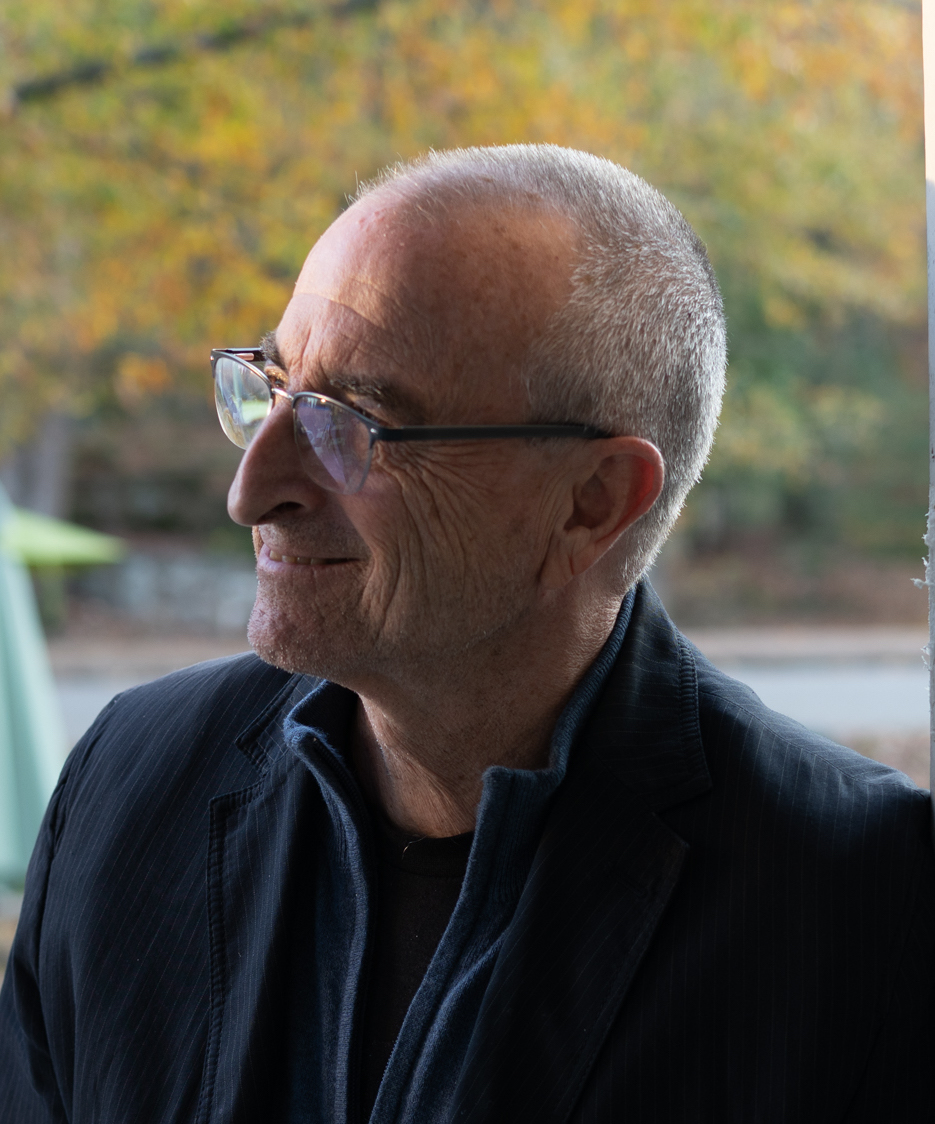
Two Poems by Richard Collins

Please note: Poetry is compressed to fit smart phone screens. If you are reading this poem on a phone screen, please turn your screen sideways to make sure that you are seeing correct line breaks for the poem.

UNCLE HARLAN

I always loved when Uncle Harlan came to visit
Not often but when he did I didn’t miss it

He was what I didn’t know existed
Something our women called sophisticated

Back again from Europe he treated us
To a slideshow: Madrid, London, Paris

He wasn’t an uncle really of course
But some distant cousin, third or fourth

Handsome Uncle Harlan had style and taste
All the women whispered it was such a waste

That he was a (quote/unquote) Confirmed Bachelor
Which meant in those days he either played the women

Or played the woman to other men. I didn’t care
He was tall and angular, long neck and slick black hair

Peppered his speech with French and Spanish phrases
Failed to teach me not tongues but how to tie my shoes

I tie them still with clumsy loops like cowboy lassoes
That elicit laughter, so I switched to loafers like his

Soft Italian leather like skin to touch
Buffed to perfection, that is: not too much

He didn’t want to be tied down. Convention kills
He confided. His European souvenirs were personal

Secrets to be savored, not shared as public art
But hidden in the hollow camera of the heart

To this kid, it was no one’s business what he did
He’d been to Paris, London and Madrid.

SACRED CITIES AND PROFANE

Tlachihualtepetl

From the Garden of Edinburgh
Back to the city of brotherly love

A taxi stuck in snow in Swansea
Never reaches London, much less Copenhagen

A train breaks down at Saint Pancras Station
Canceled pilgrimage to Canterbury

A blushing romance in Bath
A surrender, a seduction, a velvet rejection

Legs remembered and streets forgotten
Amsterdam, Paris, Brussels, the Hague.

***

A plane lands clumsy as an Albatross
On a hijacked Grecian runway

For a honeymoon in Cretan caves
Pink and black Santorini sand

Worship in the bay of Kythera
Deep bows to terraced Sifnos vines

Tours and detours of Istanbul
Drowned nudes in underground cisterns

Selçuk’s Cavern of the Seven Sleepers
The sickness not quite unto Ephesus

Then back to mathematical Samos
And the legends of long-legged Lesbos

That was one life; this is another
In no particular order.

***

Driven to city after profane city
Touching down in Sofia, Timișoara

Far from naked rocks in the sea
Corinth and Thessaloniki

To Budapest and Bucharest
Cities asleep without rest

This is one life; that was another
Mixed like a cocktail with bitters and ice.

***

What about the car wreck on River Road
What about the pool cue sold

And what about the train wreck on the way from Trieste
To Belgrade, the engineer spatchcocked on a flatcar

On the very day that protesters in Tiananmen Square
Faced down tanks, next morning headlines in Athens told us.

***

Fact is, I died long before that in the City of Angels’
Valley of Slow Death, ascended in a Delta jet

Looked out over the panorama of my youth
Dry sands of Cucamonga to muddy waters of Pacoima

From the islands of Balboa to the beaches of Laguna
A trip to Venice for the price of a pawned guitar

Stolen kisses, kitsch and country music cliches
Marriages and mockeries and blood-soaked clouds

Tumbled down at last dead drunk and lost
In the haze of Ciudad de México, then Puebla

Long before the more fortunate infidelities of the fall
Resurrection an empty promise, or threat.

Richard Collins has lived in Eugene and Baton Rouge, Bucharest and Timisoara, Los Angeles and London, Swansea and now in Sewanee, Tennessee. His recent work has appeared in The Plenitudes, Willows Wept, and Marrow. A memoir, In Search of the Hermaphrodite, is out from Tough Poets Press (2024).

Two Poems by Ryan Harper

Please note: Poetry is compressed to fit smart phone screens. If you are reading this poem on a phone screen, please turn your screen sideways to make sure that you are seeing correct line breaks for the poem.

Flight Path, St. Louis

Stressed skin—we were in descent—
there is only guessing westward
until the islands, the confluence,
the slant waters begin to tell true.

We have known Missouri by the props
and seams: levees, bottoms,
struts and stays of the highways
in crossing, headstones of Calvary
and Bellefontaine growing

on approach. We are knowing ourselves
as the great arch sways, close
quarters and wind-swung, teasing
expansive glances through small
frames—catenary upended, still
and ever bearing fantastic weight

in the base sectors. We course down
into Missouri, heavy in the current
that holds, resists our passage—
a landing just downstream from the last
great union until Cairo, Defiance,
all things between us arch
and flatter, a hyperbolic function.

Hudson Yards

Clear and Roman
the tug mid-river,
anchored with its cargo,
awaiting this day
its orders, its holdings low.

And the day arrives
in mute pangs of fire,
exacting dawn distending
between the ribs of the city
against the far shore—

the glass, the gathering flow,
the sun-drowsy vessels
clear for passage, holding
bleached economies
in freighted light.

Ryan Harper is an Assistant Professor of the Practice at Fairfield University-Bellarmine in Bridgeport, Connecticut. He is the author of My Beloved Had a Vineyard (Poetry Press of Press Americana, 2018). Ryan is the creative arts editor of American Religion Journal and lives in Bridgeport, Connecticut.

Three Roman Poems by Carlo Rey Lacsamana

Please note: Poetry is compressed to fit smart phone screens. If you are reading this poem on a phone screen, please turn your screen sideways to make sure that you are seeing correct line breaks for the poem.

I
Morning is laid out like a tablecloth
over the gardens of Villa Borghese
the whole of existence sparkles like the trumpet
moaning in full blast at the piazza overlooking Piazza
del Popolo
how the winter clothes bite the warm crust of sunlight like bread
how the ears drink the never-ending songs of fountains like wine
-songs of return songs of leaving-
and as I step into the shadows of trees
I remember what brought us here
to feast on this mystery like sheep that feed on grass
stuff our mouths with marvel and green air fill
our bellies with gratitude and poems
we stay close to each other listen to the wind
play with our hair our good intent for the world
reunites with our sorrow in the freshly cut grass
to love what is left to love in this loveless world
we lean back our heads in the light with eyes closed
as though we carry the answers

II

Temporarily on display
at the Galleria Borghese
is Rubens’ Risen Christ from 1615

to rise like the Christ in Rubens’ painting
waking up from death with a face washed by forgetfulness
not of indifference but of surrender
a face that says “it could not have been otherwise”
the dignity of the wounded
his body looks healthy and fresh
as though it has forgotten the wounds and the injury
it has suffered
even the stab hole on his lower right chest does not speak of pain
but like a tiny mouth that wants to sing
his feet longing to touch the warm earth again to walk all over again
pass through fatigue and thirst and hunger all over again
the angel lifting the shroud from his head with a surprised look
to see in Christ’s eyes the love of life as great as the suffering endured
dying indeed is the beginning for this is what Resurrection is
we are summoned to live again to love again to be hurt again
to die again

III

As old as Rome is my love for you
as chaotic as the tourists in Fontana di Trevi
is my desire for you
the way Bernini grasped chisel and hammer
I grasp you in my heat to shape this desire
to make a body of this wanting give it head arms and legs
miraculous as marble
maybe along Trastevere our glance will meet
when everyone is on his way to work when every fucking tourist
returns to his hotel when the sun grants refuge to the cold
and brokenhearted or in some corner in Piazza Spagna
where people show off their clothes or in some bar at
Piazza Navona where the fountains say your name all the time
over a cup of coffee our glance will meet
because your eyes are the city
that I feel enclosed engulfed enveloped like a gladiator
in the Colosseum but I do not fight there are no cheers
no rewards no condemnation
I am only a poet whose weapon is a flock of sparrows in his throat
whose appetite for loneliness runs further that the Tiber River
whose longing is as steadfast as your seven hills
I would rather be punished if punishment means
to be devoured by your touch
who can I make friends with here but the wind passing by like myself
sighing through neighborhoods razing the palaces and squares
with its cold breath of nostalgia
she keeps me company like a mother leading me by the hand
taking my heart to all the places where metaphors
lead to another existence where every line of a poem leads eventually
to you
yes, the wind whipping against my face exposes my heart
the heart which has too many secrets intrigues dark passages
like the Vatican but its walls crumble when it hears your footsteps
when the fragrance of your hair invades my body with tremors
and my voice is silenced like the paintings I survey for hours
at the museum searching for your face sometimes I dream of entering
the paintings of me becoming Christ crucified and you embracing me
like the Madonna weeping or me becoming Saint Sebastian
tied to a pole and you the arrows entering me without mercy
I loving the pain or I want you to be the nude like those of Rubens’
so loved by the painter you can tell by the folds and softness of their flesh
outside of these art galleries the moon wells up brighter and wiser
the lampposts flicker the river flares up the burning waters
carrying your reflection the rumble of cars over the road
the dying civilization words pile up in me like the dreams of immigrants
along the roadsides
the ghost of Anna Magnani appears in Piazza del Popolo dancing like
a madwoman
I dance with your shadow while the Neros of this world
set the temple on fire
maybe civilization is a bad idea who can tell
all these noise and madness tearing us apart
what about this dancing beneath the winter stars
the smoke-signs above the railways there is another road
we can turn into and the secret you impart in my ear
there is still a reason to live

Carlo Rey Lacsamana is a Filipino writer, poet, and artist born and raised in Manila, Philippines. Since 2005, he has been living and working in the Tuscan town of Lucca, Italy. He regularly contributes to journals in the Philippines, writing politics, culture, and art. His works have appeared in Esquire Magazine, The Citron Review, Mediterranean Poetry (Stockholm), Amsterdam Quarterly, Lumpen Journal (London), The Berlin Literary Review, Literary Shanghai and in other numerous magazines. His short story Toulouse has been recorded as a podcast story in the narrative podcast Pillow Talking (Australia). Follow him on Instagram@carlo_rey_lacsamana

“The Same Songs” by Frank Modica

Please note: Poetry is compressed to fit smart phone screens. If you are reading this poem on a phone screen, please turn your screen sideways to make sure that you are seeing correct line breaks for the poem.

A Crosby, Stills, Nash and Young
song blares from my car speakers
while I drive to my mother’s
west suburban bungalow
after a short trip to Aldi’s.
The lyrics about lost
loves ring out
unexpected, streaky
tears on my cold,
wrinkled cheekbones.
“Life is so unfair,”
I shout at the radio,
“Too many wasted days and nights.”
I don’t stop to consider
whether this same
soundtrack disturbs
the quiet daydreams
of other restless drivers
who drive around Chicago
trying to forget the loves
they lost in all
the same places.

Frank C. Modica is a cancer survivor and retired teacher who taught over 34 years. Frank’s first chapbook, “What We Harvest,” nominated for an Eric Hoffer book award, was published in 2021 by Kelsay Books. His second chapbook, “Old Friends,” was published in 2022 by Cyberwit Press.

Three Poems by Jeffery Allen Tobin

Please note: Poetry is compressed to fit smart phone screens. If you are reading this poem on a phone screen, please turn your screen sideways to make sure that you are seeing correct line breaks for the poem.

Life Through a Transom

From the transom above my grandparents’ door,
the city stretched like a secret,
half-glimpsed, half-dreamed,
a mosaic of rooftops and smokestacks,
where stories rose and vanished
in the smog-filled air.
I watched it from a distance,
my childhood framed in glass,
the world a silent play
performed on dusty streets.

Every afternoon, I climbed the stairs,
stood on tiptoe to peer through the pane,
my eyes tracing the lines of buildings
that seemed to touch the sky,
each window a portal to lives
I could never enter,
each alley a whisper
of adventures just out of reach.

The city sang a muffled symphony,
horns and shouts a muted hum
beneath my grandparents’ gentle voices,
their stories blending with the distant din,
an undercurrent of life
I could never quite hold.
I saw children playing in the park,
their laughter a faint ripple
across my glass-bound view,
their games a choreography
of innocence and escape.

I imagined myself among them,
running through the maze of streets,
feeling the pulse of the city beneath my feet,
but always, I remained
behind the transom, a spectator
to a world that moved on without me,
each day a reflection
of what I could not touch.

The city was both near and far,
a heartbeat away and a lifetime apart,
its secrets tantalizingly close,
yet always slipping through my grasp.
I grew older, my visits less frequent,
the view through the transom unchanged,
yet somehow different,
a reminder of dreams
that faded with time.

Now, I see the city in my mind,
a distant memory etched in glass,
its streets a labyrinth of longing,
its lights a constellation of loss.
The transom remains, a silent witness
to my yearning, my small rebellion
against the confines of home.
I wonder if the city remembers
the boy who watched from above,
if it holds his dreams in its concrete heart,
or if they are scattered, like leaves in the wind,
carried away by the currents of time,
lost in the endless rhythm of life.

King of the Trestle

He reigned over the trestle,
a monarch of forgotten dreams,
his kingdom stretching beneath the steel arches
where trains thundered above,
their rumble a lullaby
to the man who made the rails his throne.

Every morning, I walked to school,
passing his domain with a mixture
of curiosity and fear,
wondering about the stories etched
in the lines of his weathered face,
each wrinkle a sign
to battles fought and lost.

His eyes, clear and piercing,
held a depth that spoke of places
far beyond the bridge,
yet he chose this spot,
this concrete refuge
from a world that turned its back.
I never knew his name,
but to me, he was royalty,
a king without a crown,
whose court was the pigeons
that fluttered and cooed
like restless courtiers.

Some days, I’d see him muttering
to the ghosts of his past,
his hands gesturing to the air
as if shaping the memories
that kept him company
when the nights grew long
and the cold seeped in.

I wondered what brought him here,
what dreams derailed on the tracks
that led him to this place.
Did he once have a family,
a home filled with laughter?
Or was the trestle always his destiny,
a final stop on the journey
through a life less kind?

I never spoke to him,
fearful of crossing the invisible line
between our worlds,
but his presence left an imprint
on my young mind,
a lesson in the fragility
of human existence,
the thin veil that separates
those who have from those who don’t.

Years passed, and I left the neighborhood,
the trestle a distant memory,
its king a shadow in my thoughts.
I often wonder if he’s still there,
if the trains still sing him to sleep,
if the pigeons still gather
to hear his silent proclamations.

Sometimes, in the quiet of the night,
I imagine him sitting on his makeshift throne,
looking out over his kingdom
with a dignity that defies his plight,
a king of the trestle,
lost in the symphony of the rails,
his legacy etched in the rhythm
of wheels on steel,
a life lived on the edge,
a story untold yet profoundly known.

Milk Bottles

Grandmother’s stories poured like milk
from bottles left on doorsteps,
each tale a glass of yesterday,
frosted with the mist of memory.
I listened, enthralled by the clink
of the delivery man’s cart,
the early morning ritual
of fresh starts on silent streets.

She spoke of mornings when the city
still slumbered, when fog clung
to the corners of buildings
and the world felt softer,
as if wrapped in wool.
The bottles stood like sentinels,
gleaming in the first light,
promising nourishment
in their fragile embrace.

I imagined the sound,
the gentle thud of glass against wood,
a symphony of routine and care,
each bottle a message
from a simpler time,
a time when life was measured
by the rhythm of deliveries,
the certainty of small gestures.

Uncle Jim’s voice added a different hue,
recollections tinged with the scent of coal
and the hum of streetcars,
each memory a brushstroke
on the canvas of our family lore.
He spoke of neighbors chatting
over fences, of the milkman’s smile,
a fleeting moment of connection
in a city that never stood still.

I longed for that world,
the tangible comfort of glass and cream,
the predictable cadence of daily life,
unbroken by the chaos
that seemed to seep
into every crack of the present.
The stories were my refuge,
a window to a past
where people knew each other’s names
and the milk always arrived on time.

The tales have since faded,
their edges blurred by the march of years,
but the image of those bottles remained,
a symbol of something I could never grasp,
a time I could never touch.
I find myself yearning for that simplicity,
for the solidity of glass
and the certainty it contained,
even as I navigate a world
where everything feels transient,
where nothing seems to last.

Now, I hold these stories
like those old milk bottles,
delicate and clear,
filled with a substance
that nourishes my soul,
yet always just out of reach.
I wonder if the past ever truly leaves us,
if we are all custodians of memories
delivered from house to house,
each story a bottle waiting
to be opened, to be savored,
to remind us of the ties
that bind us to a time
when life seemed simpler,
and the milkman’s visit
was the highlight of the day.

Jeffery Allen Tobin is a political scientist and researcher based in South Florida. His poetry, short stories, and essays have been published in many journals, magazines, and websites. He has been writing for more than 30 years.

“Fickle City” by Bonnie Perkel

Please note: Poetry is compressed to fit smart phone screens. If you are reading this poem on a phone screen, please turn your screen sideways to make sure that you are seeing correct line breaks for the poem.

Sky-high stilettos echoed on the sparkling Mica sidewalks
of 70s New York, under dim yellow streetlamps
by CBGBs and the Russian baths. Oblivious to rats
scampering nearby, each beckoning corner led to a promise
of the newly possible.

This city of dreams and sorrows held me in its smoggy dome,
as the twin towers lit the starless night and seemed forever
the north star. Reaching the pinnacle, I twirled on the rooftop
dance floor of Windows on the World, adrift under a singular sky
that held me like a cocoon, vowing that I was special. I would soar.

The guru, the venture capitalist, and the Kabbalist communed
as the 80s burst forth from the sheer curtains of fire-escaped
brick. Yoga cohabited with a cocaine-infused bar scene, technology
reached in with a steely grip, and an old infrastructure crumbled.

I clung to a tattered shawl of illusion – exposed, transformed,
even beautiful now. Defined and undefined, molded
and undone, wandering through an inferno of exploding steam,
lost loves, irredeemable vertigo. Another future called –
and it was time to go.

Still, the soul of that nascent woman haunts those fickle streets,
heels keeping step with the cacophony of horns.
Loves and losses wrapped in the jangle of wild auburn hair.
Forever wandering – in the newly possible.

After many years working in Manhattan corporate life, Bonnie Perkel changed course but kept writing. She has an M.Ed. and spent several years working at Duke University Press in North Carolina before settling in the Boston area. Over the years she has been an educator/administrator, academic advisor, and editor, and she has published in anthologies and academic/trade publications.

“My Lost City” by Diana Raab

(After “Oh My Lost City” by Pablo Neruda)

New York, the place of my birth,
still hear Streisand’s words of glory—
the city that never sleeps,
even for me as a teen
who slept under stars
with sexy boyfriends and cars.

Each Sunday visited
Rockefeller Center
where dad taught ice skating
they called him Mr. Mark—
unable to pronounce his long last name—
Marquise—invented after immigration
from some French ancestors
which is maybe why I love croissants, espresso,

chestnuts and steamy nuts from street vendors.
I left before I could drive,
but now want to revisit my roots, especially
with dad gone and the city changed faces
more times than I can count.

Queens was my place, Cunningham Park
where hippies puffed joints and concerts
permeated lively words with numbered streets
and houses in rows like soldiers, only colors
setting them apart, one hundred and seventy-third street—
oh the pink shingles dad pained when I was born
to match his pink impala—
the kid mother never wanted, but dad cherished.

She planted a cherry blossom tree
in keeping with theme,
her green thumb also holding the reins of her
favorite four-legged equine partner,
always more important than me.
She’s still there, waiting to die
but never dying to live
I only wish her well— planted
in the city I used to call my own.

Diana Raab, MFA, PhD, is a poet, memoirist, workshop leader, thought-leader and award-winning author of 14 books and editor of three anthologies. Her work has been widely published and anthologized. Her poems have been nominated for the Pushcart Prize and The Best of the Net. She frequently speaks and writes on writing for healing and transformation. 

Her 14th and newest book is Hummingbird: Messages from My Ancestors, A memoir with reflection and writing prompts (2024). 

Raab writes for Psychology Today, The Good Men Project, Sixty and Me, Thrive Global, and is a guest writer for many others. Visit: https:/www.dianaraab.com. 

Two Poems by Matt Thomas

The Art Thief

She chased me down, caught me at an intersection, ran behind the car and recorded my plate on a white shopping bag which I thought was maybe from Baked & Wired, or a card shop, card shops I thought, also use those sturdy white bags, but the image of her gray head bent over the squashed bag, paling Eisenhower Building in the background, Potomac sky, 102 in August, etc.; what is called an indelible image, fled with from the scene after she strode around the car to rap the window convinced I had wronged her and I mumbled a denial unconvinced I had not, failing our interaction the same way that I failed my SATs, turning questions of fact into philosophy and so sped away when the light turned green while she shrunk in the rearview blocking E Street looking for the damage she was certain she’d accrued, thinking I’d escaped, which I had, but not with the thing she suspected me of stealing.

Metro Dancer

Requiring an audience to be alone,
flat metal strap like a barrette
between old school sun faded orange foam
headphones, cassette player humming,
an arm stretched like a cable
to the pole with a cupped hand sliding
up, down, bending knees in time
jeans hemmed by the carpet
worn black as if multitude others
had also abandoned convention
for slick chrome, every rider vibrating
above the groaning clattering,
speeding to uncertain landing pretending
to read or sleep maintaining proper frowns eyeing
the dancer, dreaming lost recalling
hand over hand that bottled fizz of youth
scratching from tinny headphones rebuking
the speeding commute, the functions and titles
shuttling up, down, a pump jack drawing
the question from where it has settled
into seams and every rider watching
also reaching, yearning, asking
where am I going, and why?

Matt Thomas is a smallholder farmer, engineer, and poet. His recent work can be read in Pinhole Poetry, Susurrus Magazine, and elsewhere. Disappearing by the Math, a full-length collection, was published by Silver Boy in 2024. He lives with his family in the Blue Ridge Mountains of Virginia.

Two Men Talking in Spanish” by Susan Kolon

Please note: Poetry is compressed to fit smart phone screens. If you are reading this poem on a phone screen, please turn your screen sideways to make sure that you are seeing correct line breaks for the poem.

On Wednesdays, she sits at the bar
at the pancake cafe. It’s 9:46 a.m.,
the slice of slow between commuter
breakfast and WFH lunch. Straight ahead,

two servers talk, rolling forks
into paper napkins. What do they talk
about? Her urban regret of never learning
Spanish. Faces not flavored with any emotion

or energy from what she can see,
their hands circle time with the leisure
of untroubled effort. The TV hangs above them,
muted. Like the golden rich of polenta

pancakes set before her, a gleaming, silent
barter. She joins the men, united
in a bubbled moment of her own labor.
Careful not to disturb.

Susan Kolon works in health education and writes from Chicago. ‘I hear a song and I can parrot the lyrics in moments. Writing poems takes me infinitely longer.’ She received an M.S. from Northwestern University and a B.A. from Michigan State University, where she was first published as a creative writing student. Her work has appeared with Corporeal Lit Mag, Dulcet Literary Magazine, Gnashing Teeth Publishing and Orange Juice, a poetry journal.

“I Prefer Montreal” by Cynthia Gallaher

Please note: Poetry is compressed to fit smart phone screens. If you are reading this poem on a phone screen, please turn your screen sideways to make sure that you are seeing correct line breaks for the poem.

I prefer Place Jacques-Cartier, where I can loll and pretend I’m Hemingway.
I prefer Parc du Mont-Royal, because the grounds were designed by the same Frederick Law Olmsted who landscaped Washington and Jackson Parks in my hometown Chicago.
I prefer Rue du St. Catherine, because the street remains lively with people day and night, as if the Internet and TV didn’t exist.
I prefer winding staircases lacing floor to floor on the outside the Montreal flats, leaving more room inside for those Catholic Canadiens with once-upon-a-time large families.
I prefer the island of Montreal, because where could you find such an urban paradise than on an island?
I prefer the St. Lawrence Seaway, the hefty, watery wonder that leads the world to Montreal’s door.
I prefer the Canadiens tolerance of my poor high-school French, entranced when I ask “Quel heure est-il? to answer “Un peu” to their “Parlez-vous francais?”
I prefer the easy road trip from eco-rustic Burlington, Vermont, to the sophisticated, continental world of Montreal.
I prefer how Chicago was once part of Quebec.
I prefer how Quebec farms look as familiar as Illinois’ but with a French twist.
I prefer to see Cirque du Soleil one day though I have listened to several of its show CDs.
I prefer to hear about Montreal’s 40-degree-below-zero winter days while surrounded by its summer flower beds and breezy fountains.
I prefer Old Montreal, a place that more North Americans who can’t afford to go to Europe can visit and get a similar vibe.
I preferred to be on Candid Camera and ended up on Just for Laughs in Montreal, which was so much more fun.
I prefer the microbrews and sorbets of Montreal.
I prefer how Montreal embraces its Native American art.
I prefer the Parisian satellite radio pumped into the Montreal hotel lobbies.
I prefer the Montreal accent, an Anglicized, flatter version that rings more familiar to my ear, with its New Yorker twist.
I prefer Montreal.

CynthiaLGallaher

Cynthia Gallaher, a Chicago-based poet, is author of four poetry collections, including Epicurean Ecstasy: More Poems About Food, Drink, Herbs and Spices, and three chapbooks, including Drenched. Her award-winning nonfiction/memoir/creativity guide is Frugal Poets’ Guide to Life: How to Live a Poetic Life, Even If You Aren’t a Poet.One of her poems will be sent on NASA’s flight to the south pole of the moon later this decade.