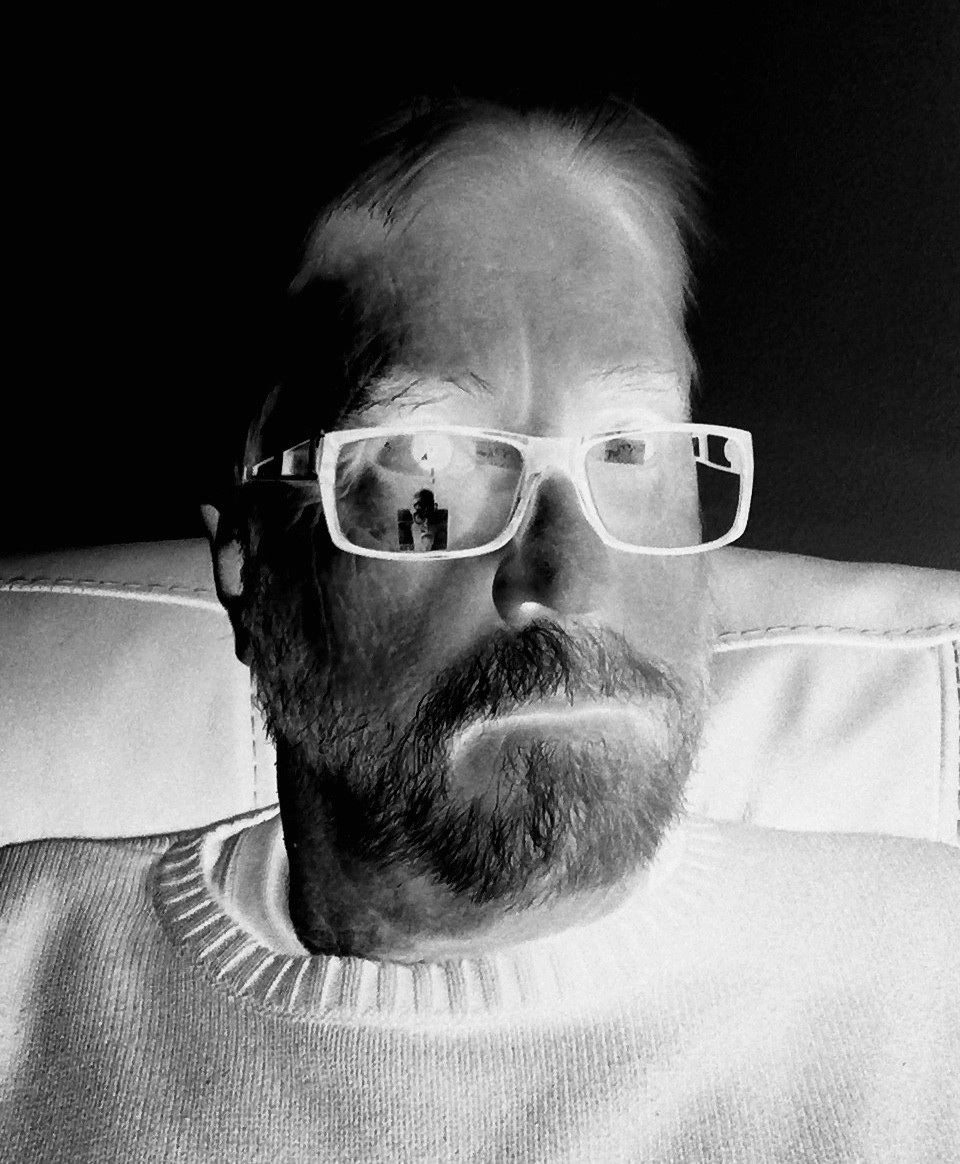
“December Speaks” by Martina Preston

It wasn’t until I left my town that I began to learn its secrets.

Winter break after my first semester in university, I drove home the back way and fell in love for the first time with the turns in the roads, the bareness of the deciduous trees on either side, river birch peeling and turning to slush in the canoes of the highway shoulder. I left my home behind and arrived at my house. I hadn’t started calling it “my parent’s house” yet. I wasn’t sure what to call it.

It was December. Over the melting of our Hanukkah candles, I learned about the child predator who used to live down the street, and whose presence kept my parents from letting me walk to my best friend’s house alone. I watched the wax make trails on the valleys and mountains of the crinkled aluminum foil that we used as a fire-safe tablecloth. I thought about the trails my feet had made across the boundaries of the town. Did he walk those same paths? My father told me these secrets. The three flames shook with the wind of his movement when he stood up to leave.

Later that evening, we gathered in a circle in the living room for gifts. My grandma knew how much my siblings and I used to love searching for the afikomen at Passover every spring, so she and Papa would hide our presents around the house so we could have the thrill of discovery. Now, we were older, and our secrets had changed. Gifts were no longer hidden, and I loved the consistency of their contents. Small squares? A three-pack of sticky notes, hopefully yellow or pale blue, those were my favorite. Small rectangles? A new book, or a pair of Kirkland Signature socks. Large rectangles? Tupperwares filled with cashews, or dried fruit, or oatmeal packets. My grandmother had other secrets to keep in mind than the location or content of a Hanukkah gift. She would tell me later.

After our nightly gift exchange, I tried out my new socks on a walk around town. Down the road from my parent’s house, the light from the inside of the red-and-white diner reminded me of an old country painting, Thomas Kinkaide and the beauty in things, or something like that. On the multicolored brick wall of the Trackside Pizza, someone had spray-painted the words “Welcome to Scumner.” That nickname was new to me. I liked plain old “Sumner.” Sumner was where my brother and I used to pick up railroad ties off the side of the tracks and replace them with our stories and legends of where they might have come from.
Sumner reminded everyone of summer, especially autocorrect. One spring, my mother stopped us from going to play with the railroad ties. I learned later that someone had died on the tracks; my father told us that they closed the road for maintenance.

Continue reading “December Speaks” by Martina Preston

“Where the City Ends” by Alfred Searls

There is a point, just before Glazebrook, where Manchester ends.

Manchester as a conurbation that is, as the relentless, English, urban sprawl that for more than two centuries has been steadily annexing the boroughs, villages and towns surrounding it.

In fact, so relentless has the advance of Cottonopolis been, if you should set off in any direction from the vast, neo-gothic splendour of its town hall, you would have to travel for quite some time before you actually left the city behind.

And even then, the civic, industrial and commercial accretions of 200 years, which surround the city like the growth rings of some mighty, iron tree, will only recede gradually, and reluctantly, before the world around you takes on a rural character.

And yet…there is a point, just before Glazebrook, where Manchester ends. And it ends with a haunting abruptness.

On my daily commute to Liverpool, just before the gleaming new train charges through the small branch station at Glazebrook, it runs along a high embankment, and each day I look down from on a single row of pretty, 1930’s villas; suburban, semi-detached and modestly middle-class.

The last house is slightly different to its neighbours, as if it had been completed to a different, more hurried timetable. Here the tarmac abruptly abates, and suddenly the fields and farms begin.

Seeing daily this abrupt end, the impression grows within me of a sudden, traumatic halt to the expanse of the city.

I can hear the lulling, Sunday whirl of mechanical lawnmowers. Gradually, one by one, they fall silent, and the sound of blades is replaced by the clipped, patrician tones of the Prime Minister, Neville Chamberlain.

His voice, broadcast live from the Cabinet Room in 10 Downing Street, drifts from window after window, in house after house, all along the warm, sunlit street.

“This morning, the British Ambassador in Berlin, handed the German government a final note…”

Mothers, casting anxious glances up at the skies, hastily recall recalcitrant children from freshly planted gardens.

“…stating that that unless they were prepared, at once, to withdraw their troops from Poland…”

Fathers, rigid with silent anger, wonder when the call-up will begin.

“…I have to tell you now that no such undertaking has been received, and that consequently, this country is at war with Germany.”

The urban advance has been checked, for now. But the future can still just about be glimpsed, further down the line.

Alfred Searls was born, bred, and indeed buttered in the city of Manchester. After a grimly successful career in PR and marketing, which left him with a nagging suspicion he was becoming a character in a Kafka novel, he decided to start writing things he actually wanted to write.

“Gulbenkian Gardens, Lisboa” by Maria Duran

alright, i have to say it: so the daisies do die,
also the ducks, also the children frolicking green-kneed-
they learn Algebra and then they forget it,

they get mortgages and get prejudiced,
they lose themselves, lose their senses.
if they ever step through flowers of this same garden,

tomorrow or a decade or a lifetime after
running green-kneed through their childhood,
they will not feel its spring (singing in their blood very loudly)
as if it was natural for good springs to happen.

still the ducks remain, wise of eye,
their flight a rare thing in the summer,
their coming easy to love in the winter,
in every life’s winter
in every life.

Maria Duran (she/her) is a researcher and PhD candidate in Art History from IHA-NOVA FCSH in Lisbon, Portugal. Her literary work has been published Gilbert & Hall Press, Black Moon Magazine, The Ekphrastic Magazine, tiny wren lit, Iceblink Lit, among others. Her visual essay has been the cover of Sophon Lit Magazine. She was a finalist of the 2024 Lisbon Poetry Festival, and has been nominated for the 2025 Best of the Net award. Her poetry debut wasl published with Urutau Press. (@m.mar.duran) • Instagram.

“Tangiers, July” by Hillary Smith-Maddern

Please note: Poetry is compressed to fit smart phone screens. If you are reading this poem on a phone screen, please turn your screen sideways to make sure that you are seeing correct line breaks for the poem.

On this infinitely sunny day,
after a long ride in a surfer’s van,
the moon begins its glow behind stone
mosques. In the turrets’ shadows,
the broken light of stained glass
windows searches for untouched
surfaces. Defiant street cats,
the dingy angels, stretch,
reluctant to begin their search
for the evening’s sustenance.

It is my best friend and me in Tangiers,
holding the first breath of summer
to the wine bottle’s open mouth.
We would like to believe it is too early
and too late, so there is still
time, that the sunset will laze on
until morning, that our magnificent
suffering has poured itself a tall
glass and sits in silence beside us.

Hillary Smith-Maddern (she/her) is an educator and committed dilettante. A proud cat lady and avid collector of neglected plants, she enjoys diving into the shallow end of everything and scrolling casually through JSTOR. Currently residing in Western Massachusetts, she aspires to fake her death and never return to America. She will obviously take her cats with her. You can find her work in Whale Road Review, Only Poems, and The Disappointed Housewife among others.

Two Poems by Kenneth Reimer

Please note: Poetry is compressed to fit smart phone screens. If you are reading this poem on a phone screen, please turn your screen sideways to make sure that you are seeing correct line breaks for the poem.

Drowning

It’s during the day when they come.
They shuffle in before noon
and sit in the dark corners of the bar
drinking beer and rye.
They rarely talk,
except to shout at remembered faces
of people they loved
and drove away.
I’m witness to these moments of pain,
and hope that I never grow old and alone.
I’m helping them kill themselves.
It takes a long time, but the poison will eventually work,
and there are always others to fill these empty seats.

Writing on Napkins

Writing on napkins
and scrapes of paper
make me feel inspired.
Little treasures of thoughts and words
forgotten on cluttered tables.
I came on them seldomly
as a waiter searching for my own muse
(in the off hours before sunrise),
and I wondered what it could mean
to find such scattered messages:
a list,
a request for rendezvous,
an expression of joy
or sorrow,
and sometimes a poem –
scribbled and discarded,
left behind by a vagabond artist,
left behind to be read and loved by me.

Kenneth D. Reimer lives on the Canadian Great Plains with his wife, Lisa, and a cat named Nazca who likes to bite him on the leg. His favourite art form is the short story, but occasionally he takes on the challenge of longer fiction ranging from novellas to novels. He has had short works published in a variety of magazines and anthologies including The NightWriter Review, Four TulipsThe Saint Katherine ReviewThe Brussels Review, and Scribeworth MagazineZero Time, his novel of time travel, is available on Amazon. Samples of his other writing can be viewed at KennethDReimer.com.

“Charge of the Night Brigade” by Linda Romanowski

From 1/6/1996 to 1/8/1996, 30.7 inches of snow fell in Philadelphia.

My husband and I lived in NE Philadelphia for 23 years. Our row house was located on a small one-way street, with parking on both sides. There were several snowstorms in 1996. One in particular brought much havoc into our neighborhood. It was an all-day snow socker, which conveniently ended at 9:00PM. As all of us gathered outside to shovel through the damages, a plan emerged.

We knew we would be trapped for days, with no hope of any city assistance. It was decided that we would get ourselves out of the mess by working together. One of our neighbors had access to a snow plough. Every able-bodied person, teenagers included, set themselves to the task at hand. One by one, two by two, alone and side by side, we dug every car out of the snow. There were several elderly neighbors who gladly threw their car keys from their windows when we knocked on their doors to explain our idea. I can still see and hear those keys flying through the air.

The women who were not shoveling canvassed the street with coffee, tea, hot chocolate, gloves, hats, scarves. There was so much snow, we made every child’s dream come true when snow forts appeared on their front lawns the next morning.

The final act was a drama in itself. Each car was moved out of its spot, cleared of snow, plowed out of their spot, and re-parked. Clearly, there were moments of danger. Clearly, it was exhausting. All was done before dawn’s shocked arrival at the sight of mission accomplished. The Noble Act of Neighbors ended.

Thereafter, parking was a non-event. It has been many years since I’ve thought of that crisis. My mind’s eye still sees the men’s arms flailing like speed skaters, their efforts causing the snow to part like the Red Sea. Just as the Amish raised the barn in the movie “Witness,” we raised the bar of decency and conquered the aftermath of the storm. There was no better moment than that one.

Some of you who might read this were part of that miracle. Know how very grateful I am to have been your neighbor, to have worked shovel to shovel with you that night.

My mother would always say that good neighbors are a gift from God. That’s how my husband and I were raised. That’s how my husband and I raised our shovels, did the coffee runs, and caught jangling keys before they could be lost in the white avalanches.

Thank you again, former wonderful neighbors of Mayfair. You will always have a special place in my heart. I remain forever grateful.

Linda M. Romanowski Linda M. Romanowski returned to Rosemont College (Class of 1975) to obtain an MFA in Creative Writing, Non-Fiction in 2021. Her thesis, earned with distinction, became her debut hybrid Italian memoir, Final Touchstones, published by Brown Posey Press, an imprint of Sunbury Press in January 2023. Her non-fiction and poetry publications include The City Key, the Mario Lanza Institute Facebook page and website, Moonstone Arts, Ovunque Siamo, and Vine Leaves Press. Her book reviews appear in Philadelphia Stories magazine, the Italian American Herald newspaper, and the US Review of Books. The Historic Society of Pennsylvania and the Library Company of Philadelphia accepted Final Touchstones into their collections in 2023. Final Touchstones earned Finalist status for the Eric Hoffer Book Award for 2023, for memoir, culture, and poetry, and is nominated for their Legacy category for 2025. “Final Touchstones” won the Sunbury Press 2023 and 2025 SUNNY Award for Non-Fiction. “Bearing Witness,” an excerpt from Final Touchstones was included in A Conspiracy of RavensA Collection of Work by Rosemont College MFA Alumni, Spring 2025.Linda is a member of the Book Authors of Southeastern Pennsylvania and can be found at www.LindaMRomanowski.com.

Three Poems by Shontay Luna

Please note: Poetry is compressed to fit smart phone screens. If you are reading this poem on a phone screen, please turn your screen sideways to make sure that you are seeing correct line breaks for the poem.

Weekend in NOLO (sometime in twenty thirteen)

He signed up for one of those time-shares
presentation deals at the mall without my knowledge.
Under a big sign that said “Free Weekend in (insert any
city name here). Includes three-day stay at such-and-such
hotel, just fulfill attendance presentation requirement.
Of course, they tell you that afterwards. It was cool riding
down a freeway I’d never seen before, developing a new
affinity for the number “ten”. We were within walking
distance of the French Quarter with its multitude of
bric-a-brac stands and shops. Open air bars
beckoning us in and disposing massively
inebriated tourists back onto the street at 12:30 in
the afternoon. My only regret at the time was that
I considered it too early to drink. From there we
went to the seafood place recommended by a
local at the meeting where there was a bit
of a wait but the food was fantastic.
During which I got to see a bonafide, second
line parade. The happy couple strutting
behind the brass band, followed by the
attendees. Sound filled the street outside.
It was normal and slow motion both at
once.

Afterwards, we walked along the streets
whose shores kissed the edge of the
Mississippi. Picked up a card from a
coin-operated fortune teller. Can’t remember
what the fortune said, but it was good
(I believe they always are) and I kept it for
many years. And the time flew. Before I knew
it, the weekend was over. As we hit the road
toward home, I made a promise to myself to
one day, return to New Orleans. When I had
just a little more time in my pocket.

My Return to NOLO, Part Two (January 6-8th, 2023)

I made it back to NOLO, several years after my initial visit.
Hotel room absolutely lovely; with its kitchenette and extra
bed that I didn’t need. Maybe I was so excited to go, I forgot
to order a single bedroom. View was of other windows, but if
I looked to the right, I could see the Jackson Avenue traffic
bustling under a sky tinged in amber sunsets. My, how those
streets called themselves to me as I walked the nearest ones.
getting a latte and chocolate croissant a block away, staring
at both the streetcars and palm trees in absolute wonder.
When I found Canal Street, my prior recollections came to life.
Returning back to me fully in real time, I remembered. Even
though I was still heady from both the travel high and densely
erotic dreams in the early morning hours as my eyes witnessed
both a sea of stars and fleur-de-lis.

The possibilities are endless for I am “home” in a place
I wasn’t born in, but my people were. Albeit two and a half
hours away. And somehow, the city knows it as I feel its
embrace around me.

This trip a complete contrast to the one before. Yet,
it doesn’t phase me at all. Because there’s something
different here about the Sun and sky; the vibe so
distinct. Maybe it calls to me because it’s the land
of my mother’s people, the land of my Great –
Grandparents. Maybe it just wants me, period.
I don’t know why it feels like this – I’m just glad
that it does.

Back to the palm trees – yes, the palm trees. Being from
Chicago, I find them fascinating. I stare at them
helplessly upon my outings, in awe of the varying
heights and the unrelenting casualness they
embody.

Return to NOLO, Part Three

Travelling completes the soul. That’s the only way
I can explain it. I once had a co-worker that had
several tattoos. Every time I’d see her, she’d show
me her newest tat while excitedly talking about the
next one she’d get. I’ve realized how she felt about
tattoos, I feel about travel. As I sit here in the
airport terminal, all I can think about is where my
next trip will take me. The thought leaving me
excited, breathless and grateful as this last trip
was years in the making and sorely needed.

As it was winter, I didn’t smell magnolia in the
breezes, but I felt the ragtime rumble itself
through me in an off street by the French Market. I
traipsed on cobblestone streets among buildings
brocaded in metal flowers and secrets.

Canal Street crept quietly into my memories,
with its broad width and sun setting horizon.
The ancient souvenir shop I frequented
the first time still standing on the corner.
The large white sign with black letters, an
antique in the digital age. Now flooded by
several CBD shops that, of course, weren’t
there in years past.

I forgot to return to Duke’s for the seafood,
but I did go to Cafe Du Monde and
The Court of the Two Sisters Buffet.
Flavors staying with me long after
delicacies were consumed. As the titles
ingrained themselves in my memory –
Red Beans, Shrimp Etouffee, Gumbo,
Jambalaya. And I’m left with two
certainties: New Orleans calls me like
no other city ever has and I will definitely
return.

Chicagoan Shontay Luna is a poet, blogger and fanfiction author. Her work first appeared in Anthology and Capper’s and her most recent appearances include The Crucible, Press II Press and Blue Lake Review. Her newest book is ‘The Goddess Journal – a tool for unlocking the Goddess within every Woman.’