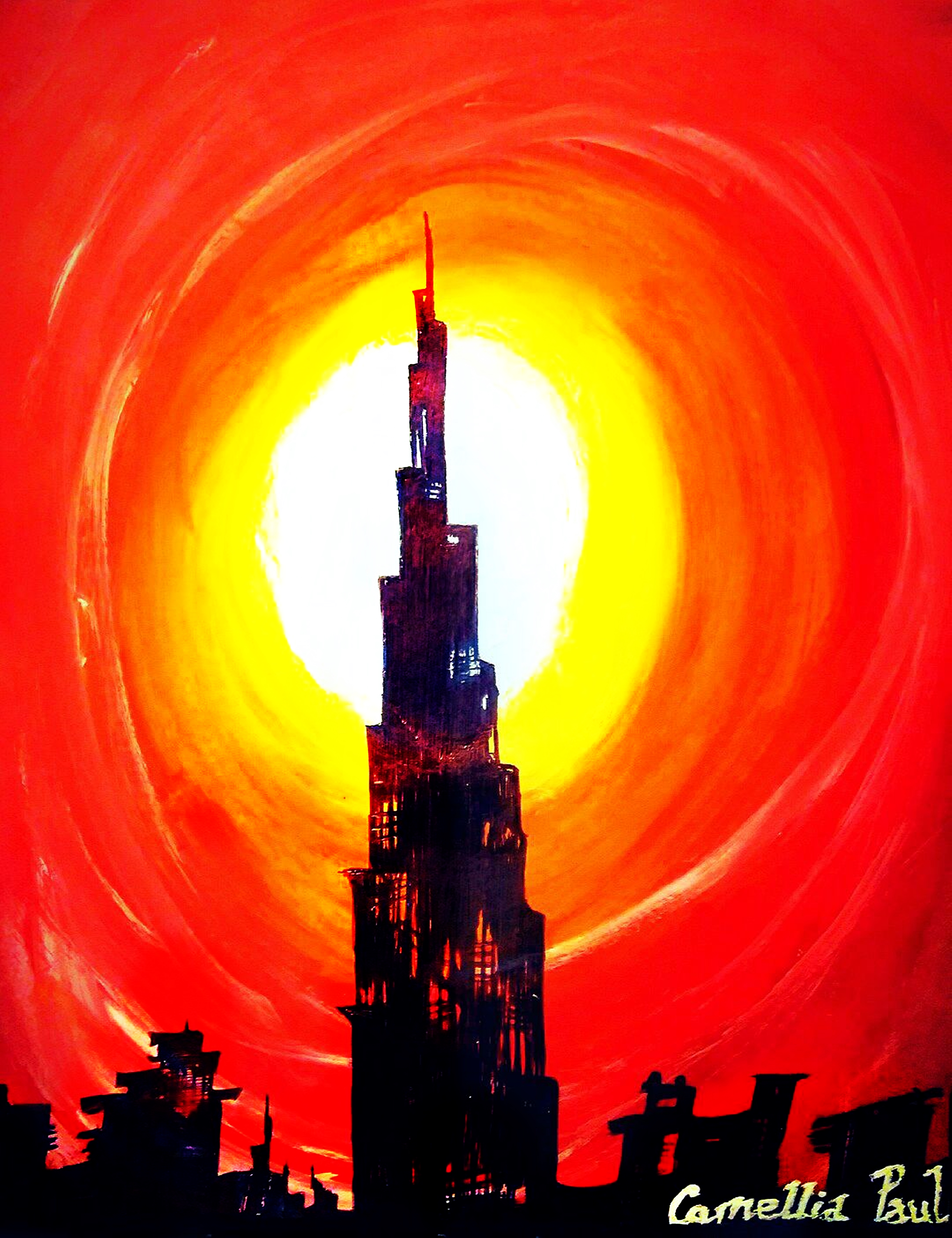
Enter the City


“Hagia Sophia” by Camellia Paul

Camellia Paul has a Masters in Comparative Literature from Jadavpur University, India. She works as a Senior Instructional Designer in a multinational ed-tech company.

Her works of translation, fiction, poetry, and art regularly appear in magazines, online journals, and anthologies. Camellia loves owls, reading, listening to music, and exploring cultures.

“The Only Girl’s Awakening” by Dorothy Venditto

This summer night began like so many before. Supper was over, and my mother said it was time for all of us to move to the living room so she could finish washing the dishes. I wanted to stay behind to help clean the kitchen and to be with my mom, but I was just 5 years old and wouldn’t have been much help. So, I followed my five older brothers and father into the living room as expected. I can’t remember what we were watching that night but imagine it was one of my father’s favorite cop shows. The younger kids got a seat on the hardwood floors, the older boys fought over a space on the couch, and my father collapsed into his chair in a way that signaled he was not getting up again.

On my favorite nights in our apartment, which this one was not, I could gaze through the open window from my seat on the floor and see the setting moon competing for attention with the Empire State Building. I could not seriously consider which would win such a competition because I felt their magic equally. I’d often find myself listening to the conversations of people walking on Third Avenue as their words and laughter made it through the thick summer air to our second-floor apartment. Groups of men loudly talking about the game they just watched at the corner bar and women considering where to go while hailing taxis – these types of conversations kept me listening for what might come next. I saw myself wearing shimmering high heels and a long, dramatic black coat and wondered where I would go when I was old enough to hail taxis on my own. Listening in on real people’s lives and creating imaginary ones for myself always won over TV storylines.

Sometimes, bad weather obstructed my view and street conversations leaned more toward conflict than celebration. Still, there was comfort in the routine hum. Ambulances often raced by, rousing me from daydreaming. One brother would mention, probably for the hundredth time, that it’s an emergency block for Bellevue Hospital, so you have to put up with the noise. But my oldest brother, who didn’t much like the high pitch sounds, almost always got up to close the window and shut out the sirens.

Continue reading “The Only Girl’s Awakening” by Dorothy Venditto

“Secular Ascension” by James B. Nicola

No matter how long we live
No matter how alone we lie
We are all unborn
And all deceased
For the same amount of time
And the same distance from each other
Whatever that distance may be.
Call it eternity. Call it infinity.
But like an ocean and its islands
Eternity is interrupted
By us.

No matter how high up we reside
We are all the same distance from heaven.
A lifetime.
A universe.
But a universe interrupted.
By us.

*

I live forty-five floors above Hell’s Kitchen in the middle of Manhattan.
It is my favorite place on or above Earth.
The view takes my breath away. Every day.
If you visit me, the view will take your breath away.
In such apartment buildings, the elevator is everyone’s friend.
When you visit me, the elevator will be your friend.

When the world below and outside happens to be hell and storming
With squalid snow, hectic hail, incorrigible ice, or rambunctious rain,
I stay inside instead of jogging, walking, biking, or hiking.
I stay inside so as not to catch cold.
So as to stay healthy.
On such days, I walk up the stairwell a few times
For the cardiovascular exercise.
I ascend to stay healthy.

The stairwells in such apartment buildings have no windows and no view.
It is the climb that takes my breath away.
If you visit and walk with me, the climb will take your breath away.
Then I shall cook you a meal from scratch.
If you visit me, you may feel healthy.

*

I grew up near Mt. Wachusett, Thoreau’s favorite mountain, in Massachusetts.
It’s become a favorite climb, even after a storm, branches of pine and birch,
rocks and roots strewn everywhere, a landscape mid-revision.
It’s not one of the holy mountains of the world, like Croagh Patrick in Ireland
which I’ve scaled or Denali in Alaska where I’ve hiked.
But Thoreau walked to Wachusett from Walden Pond and scaled the slope, and
he was a holy man, in a secular sort of way.
I hike to the top, then stroll down, at least once a year. When I happen to be
In Massachusetts.
I even walked to Wachusett once from Walden.
Always I breathe in the view as well as the air’s green perfume.
What exhilaration!

At the top of the mountain, I feel
As if I am on, or even am,
An island in the air and, oddly,
Not so far from either home or
Heaven.
Back at the bottom, spent, I feel
Healthy.

*

I think and feel and care, never far from You.
You are my favorite hope, like a favorite mountain,
Even when I’m confused, even when I’m an island.
After a calamity, not knowing where to turn, I glance up and ask, “Now, what?”
At times from the top of a building.
At times from the top of a hill.
And at times I have heard You answer me.
I thought I heard You answer me.
I’ve heard and hear You answer because
You take my breath away.

Each breath I take
Each blink I make
Is an elevator door slid open,
A button pushed, a panel lit,
A pace down a corridor,
A step in a hike on
A rocky, root-strewn climb
Toward the summit of a desultory life.
Toward the summit, I suppose, that’s You.
There is no down.
But what exhilaration!

And one day,
One year,
After all my years and days are done,
I shall be no longer the interruption,
No longer the island remote.
I shall be forever
Home.

And this is the only exercise, the only true exercise, the only breath truly taken away.
This is the only ecstasy: the thrall of impending rapture.

jbNicolaimage_option1

James B. Nicola is the author of eight collections of poetry, the latest three being Fires of Heaven: Poems of Faith and Sense, Turns & Twists, and Natural Tendencies (just out). His nonfiction book Playing the Audience: The Practical Actor’s Guide to Live Performance won a Choice magazine award.

Please note: Poetry is compressed to fit smart phone screens. If you are reading this poem on a phone screen, please turn your screen sideways to make sure that you are seeing correct line breaks for this poem.

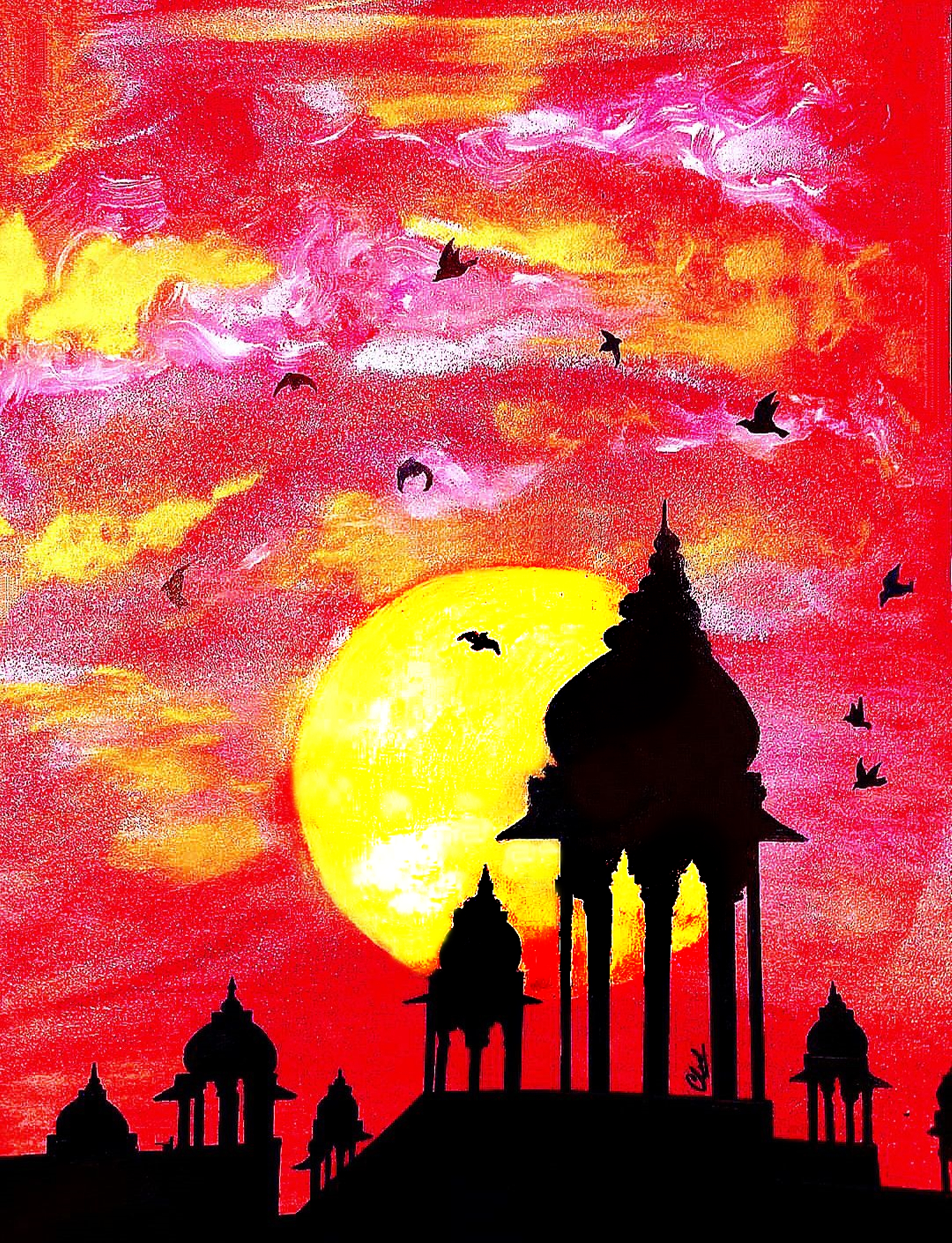
“Nakhoda Mosque” by Camellia Paul

Camellia Paul has a Masters in Comparative Literature from Jadavpur University, India. She works as a Senior Instructional Designer in a multinational ed-tech company.

Her works of translation, fiction, poetry, and art regularly appear in magazines, online journals, and anthologies. Camellia loves owls, reading, listening to music, and exploring cultures.

“Burj Khalifa” by Camellia Paul

Camellia Paul has a Masters in Comparative Literature from Jadavpur University, India. She works as a Senior Instructional Designer in a multinational ed-tech company.

Her works of translation, fiction, poetry, and art regularly appear in magazines, online journals, and anthologies. Camellia loves owls, reading, listening to music, and exploring cultures.

“Watercolor: Umbrella with Girl” by Jeff Burt

August rain,
her umbrella taut
as a puffed cheek,
a gust and she’s dragged
like a rag doll.
Soon, rain absent,
slack as an accordion,
she twirls it
like a baton
as if orchestrating weather.
In softened soil
at Gault Street Park,
she turns the umbrella
into a walking stick
poking holes
by the sidewalk
some will believe
have been made
by tunneling creatures.

Jeff+Burt+NP1

Jeff Burt lives in Santa Cruz County, California. He has digital chapbook available from Red Wolf Editions, Little Popple River and Other Poems, and a chapbook from Red Bird Chapbooks, A Filament Drawn so Thin.

Please note: Poetry is compressed to fit smart phone screens. If you are reading this poem on a phone screen, please turn your screen sideways to make sure that you are seeing correct line breaks for this poem.

“The Moon in Palermo” by Jane Rankin-Reid

In the early mornings, the sound of horse’s clip-clopping on the cobbled Billiemi marble of Palermo’s streets feels timeless. My experience of these echoic memories from across the ages is as strong as the sensory reflections certain aromas evoke. Later in the day, horses harnessed to ornate open carriages stand as their drivers idle, smoking and gossiping on Via Vittorio Emanuele, waiting for tourist fares. The odor of horses is ever present in Palermo’s ancient inner-city streets. It sometimes feels as if nothing has changed in the last one hundred years. Horses feel as if they’re part of the city’s sense of overlaying loss. Their contemporary presence lends an air of surreality to Palermo’s undercurrent of historic madness.

Last year while visiting on an extended sojourn, I often spent a part of my mornings lying beneath the Greek-Italian artist Jannis Kounellis’ Untitled series of nineteen old-fashioned wardrobes and cupboards. These unexpected objects are hung by steel wires from the ceiling on the first floor of the Palazzo Riso, home to Palermo’s Museum of Contemporary Art. Kounellis’ menacing flotilla of gravity defying objects loom overhead like a flock of heavy wooden birds. My experience of lying on the cool polished terrazzo floor beneath these airborne old cupboards, some with doors open dangling carelessly, is an intimate ‘suspension of disbelief’. This momentary flight of logic and rationality is an experience created by sheer daring, both mine and the artist’s. It is an artwork that invariably sent me out on my day’s journey exploring Palermo in a state of boundless wonderment. The installation opened my sensory pores to the potencies of the many myths and superstitions I frequently came across in the City of Happiness. It became one of my most favourite rituals, an inventive reverence of the flight of human creative imagination.

I kept running into the moon during those hot early July days. That morning, it was the fourth time we’d met in the last week. First, on Monday when it was being assembled on the pavement outside Giardino dei Giusta (Garden of the Righteous). There was something essentially convincing about its arced, white-painted slatted timber form rearing upwards in its rawest state. Workers crawled over its emerging shape with nails held between pursed lips, hammers dangling from worn leather tool belts. The next day though, it had not moved, the moon seemed to have become more secure in its identity. An indigo blue ‘sky’ of felt had been attached to its base. A day later, in a park closer to my home, the moon’s incarnation as a float for the upcoming Santa Rosalia festival parade was almost complete. White fluffy cotton ‘cloud’ pads were being stapled onto its nether regions. Santa Rosalia, dressed in pastel green robes, her long blonde hair rippling in pasty curls, had been erected to look as if she was astride it.

Continue reading “The Moon in Palermo” by Jane Rankin-Reid

Two Poems by James Conroy

EVERY CITY IS MY HOME

Someone says my name
in another place as if they know me.
Every bus, every train is a homecoming.
I see my father in a stranger’s eyes
and my mother on a billboard.

Every city is my home,
mountains and prairies in the yard.
I tend to things the way this river
spreads itself in high-water season.
My clothes fit every occasion.

Every city is my home
though I am always going;
horns and sirens late at night
and a newspaper in the morning.

NO ONE SAYS…

“Correct me if I’m wrong,”
and means it.

‘L train rumbles by;
rumbling because it never
wants answers
to questions it hasn’t asked.

If I cross another bridge
will the river feel diminished?
The river heeds my concern
so we remain friends.
It will still freeze next month.

I pass an old building in demolition
and think it was a school, once.
Might have been.
I taste the chalk.

J. Conroy. heashot.3

James Conroy is a writer and editor living in Chicago. His poetry and short fiction have appeared in BLUE UNICORN, THE CAFÉ REVIEW, XANADU, THE ICONOCLAST, FREEFALL, SPEAKEASY, and the THE GROVE REVIEW among numerous other distinguished journals. He has also published a collection and eight novels.

Please note: Poetry is compressed to fit smart phone screens. If you are reading this poem on a phone screen, please turn your screen sideways to make sure that you are seeing correct line breaks for this poem.
“City Lights of Calcutta” by Camellia Paul

Camellia Paul has a Masters in Comparative Literature from Jadavpur University, India with specialisation in Canadian literature and translation studies. She currently works as a Senior Instructional Designer in a multinational ed-tech and professional services company. Prior to this, she has worked in print media and publishing houses of international repute, and been part of various academic translation projects. Her works of translation and fiction have been published by The Antonym. Her poetry and art have appeared in magazines and anthologies, as well as online journals like Livewire, The Fabulist, The Passionfruit Review, Setu, Troublemaker Firestarter, among others. She also has published photographs in The Telegraph, Kolkata and Setu. She has designed academic book covers and posters for international conferences, published by educational and research institutes, such as Sahitya Akademi, Jadavpur University, and Ashoka University. Currently, she is also learning Arabic. As an independent practitioner of the visual arts and photography, she has extensively worked on the interface of narratives from the everyday in a pandemic world across rural and urban spaces. Apart from being passionate about art, owls, and gardening, Camellia loves reading, listening to music, and exploring cultures. Camellia’s on Instagram handle: cammeowl. https://www.instagram.com/cammeowl/

Three Poems by Michael J. LaFrancis

The Goal Rush

Grand Central Station next stop.
Exit to the right of the train.
Watch the gap between the car and the platform please.

Thousands climb the stairs and converge
as they pass the golden clock tower,
that perches above the ticket counter.

The pounding of their leather heels
against the tile floor
sounds like a stampede

toward a set of stairs, these down,
to the Red Line 1, 2, 3
to the right side for Uptown, left for Downtown.

As the next train arrives the brakes are screeching,
the number or letter and destination is flashing
in red colored lights. The door opens, some get out.

Those who have been waiting push forward
trying to make sure they get all the way in,
before the door closes in front of them.

Some look forward, some look out
for the white letters and numbers
painted on black placards

This is 14th Street, Union Square.
The next stop is Brooklyn Bridge, City Hall.
Transfer is available to the 4, 5, J, and Z trains,

At the end of the day or week,
they will reverse this migration
to arrive home again.

I am in awe how many millions of people
can get where they want to go,
with a few simple signs for direction.

What Will Become of Me?

While so many of you
were under lockdown,
my clock at Grand Central was still

on duty directing traffic;
my trains and buses were delivering
those working to keep you alive.

I see you looking beyond your masks
into each other’s eyes, perhaps seeing
a cocktail of emotions for the first time

shaken and stirred are your stories
loss with longing,
like those that have been told before.

We will need to open our hearts
wider and deeper for me to be THE City
in your American dream.

The Dream

Your eyes are blue like the ocean,
observed the customs agent
at Beijing International.

“They are my mom’s eyes.”

A Chinese photographer
was taking pictures of me
in a tan fedora, brown felt boots,
snapping photos on my phone.

Cream-colored condos climb
out of the ground, like hollyhocks,
as bankers and investors play poker,
matching and raising tall buildings.

Cars crowd the throughways,
like ants on a hill. Tail lights,
street lights, and lanterns, all red,
decorate large cities, not scooters or bikes.

Our official tour guide,
a dark-haired woman, 30ish,
tells us everyone wants cash,
credit, cars and condos.

Permits are issued for alternate days of the week
that allow us to drive and run air conditioning,
guns and knives are not allowed in public,
police carry wooden clubs and walkie talkies.

China Dream was written in calligraphy
on a sign posted on a green construction wall.
“What is China Dream?”

We want harmony with our spirit,
in our relationships, meaningful work,
health and prosperity now, in the afterlife.

Michael

Michael J. LaFrancis is a trusted advisor and advocate for individuals, groups and organizations aligning purpose, capabilities and ideals. Writing poetry is a contemplative practice providing him with insight and inspiration for living a life imagined. He and his partner Sharon are co-authors of their autobiography.

Please note: Poetry is compressed to fit smart phone screens. If you are reading this poem on a phone screen, please turn your screen sideways to make sure that you are seeing correct line breaks for this poem.