“Under a Verdigris Streetlamp” by Sara Backer

Please note: Poetry is compressed to fit smart phone screens. If you are reading this poem on a phone screen, please turn your screen sideways to make sure that you are seeing correct line breaks for the poem.

Paris Street; Rainy Day by Gustave Caillebotte

“Like real weather atomized”—Ciaran Carson

Caillebotte’s pale clouds fight to hold back
the sun, rain pooling between worn cobblestones, a shimmering
veneer, flatiron buildings nosing into a five-point intersection.
When I went to Paris, neon lit a dark sky. Cobblestones now paved.
Wheezing buses blocked my view. Caillebotte’s streets have no cars.
Pedestrians space themselves, walking in all directions, holding identical
umbrellas, large and curved, the color of sealskin. The closest couple
turn their placid eyes to look at something beyond the edge
of the canvas. The man wears a top hat and bow tie. His wife
wears diamond earrings and a fur-collared coat. She holds his arm
that carries their umbrella high. Brick walls, muted ochre, could be gold
with a bit more optimism, sluiced in the mesh-like rain.
My December was chilled by drizzle, no coffee or brandy capable
of even transient warmth, and I, who cherished solitude, wished
I had someone to joke about conformity or bourgeoisie. I rode
the warm subways so often I memorized metro maps.
At Gare Saint-Lazare, a couple asked me how to get to Opera.
I understood their question, told them in French how to get there.
My sudden competence thrilled me! The husband frowned
and murmured, elle n’est pas francais. They asked a young man
the same question and he repeated my answer. Suddenly sick
of rain and trains and tiny cheese sandwiches,
that evening I left for Italy.

Sara Backer’s first book of poetry, Such Luck, follows two chapbooks: Scavenger Hunt, and Bicycle Lotus, which won the Turtle Island Chapbook Award. Recent publications include Lake Effect, Slant, CutBank Online, Poetry Northwest, Poetry Ireland, and Kenyon Review. She lives in New Hampshire and is currently writing novels.
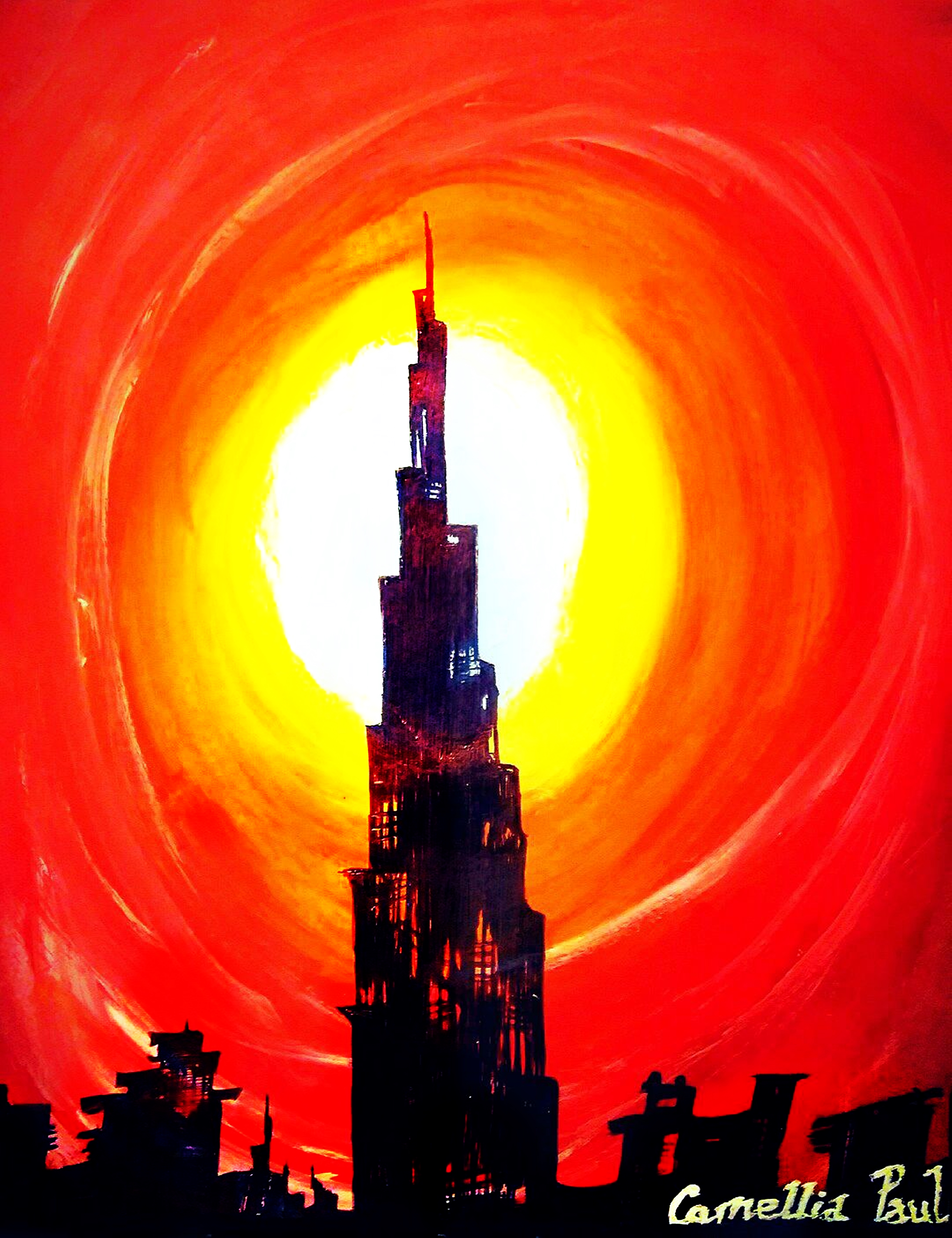

“Burj Khalifa” by Camellia Paul

Camellia Paul has a Masters in Comparative Literature from Jadavpur University, India. She works as a Senior Instructional Designer in a multinational ed-tech company.

Her works of translation, fiction, poetry, and art regularly appear in magazines, online journals, and anthologies. Camellia loves owls, reading, listening to music, and exploring cultures.

“Royal Street 2020” by Theresa Pisani

Theresa Pisani has been a fine artist and professional muralist for many years, with a focus on capturing the light on her subjects, whether it be dawn or dusk, night, or a cloudy day.

She is also an animator, illustrator, and has lived and worked in the redwoods in Sonoma county, California and Orcas Island, Washington. Today she divides her time between New Orleans and California.

“Afterwards” by Gene Fendt

The hurt purple of evening’s clouds
has pulled its quilting between the rooves and stars,

and winter spreads its tablecloths
upon the dozen building tops within his view.

Only the table in the farthest corner
has a light,

awaiting the happy couple
whose reservation has been cancelled.

                              *

In the gathering dark the snow appears
as a prayer of the heart spoken

long before it is known by the mind,
as once they had entered each other’s lives,

as wind begins its quiet dance with snow.
The deeper dark behind him grows:

the quiet sanctuary abandoned,
he stares at the single light.

                              *

Every table is the most expensive in the house:
the one at which no one is seated;

the lit one is exorbitant,
but for it we would not be open.

Only by accident and unknowing
will both be in this city again,

though the fresh linen snow will fall
a dozen times this winter,

starched to the crisp fall at the corners
on the tables they once looked upon

with love.

Geneheadshot24

Gene Fendt is the Albertus Magnus professor of Philosophy at the University of Nebraska, Kearney. His first book of poetry, “Eternal Life and Other Poems” will be published early in 2025 by Angelico Press.

Please note: Poetry is compressed to fit smart phone screens. If you are reading this poem on a phone screen, please turn your screen sideways to make sure that you are seeing correct line breaks for this poem.

“The Spectator Takes a Journey” by David M. Rubin

Looking back what seemed a stray puppy was actually an old little dog and coordinator of an incident that was still raw like the scrapes on his elbows and knees. He had no idea what to make of the even earlier incident with the crows but sensed all was connected.

Archer Fennis woke up that morning, reciting his mantra of “no humming”. Humming was a signal to his nervous system that there was something to be worried about, maybe everything. Then sweating. Then cold hands. Then pacing. Then anticipatory moaning. Then the full-fledged Munch-like scream. No humming, no humming, no humming.

The white living room walls were devoid of paintings or posters. The emptiness was unendurable, a continual incitement for Archer to Jackson Pollack his carefully curated red ceramic bowl of granola, almonds, blueberries, and soy milk against the wall. He had no coffee table and wondered what if one wanted to display art books, but had only one folding-table placed constitutively in front of the TV. He placed the cereal bowl gently on the blonde wood and consciously struck a pose of one intent on terraforming.

Archer laced up his Merrills, grabbed a baseball cap (orange with a Jayavarman II face), black pandemic mask, and a credit card. He would buy eight art books. Eight. He would keep them on a stack on the floor next to the folding table and each Sunday he would ritually rotate up a new one.

Continue reading “The Spectator Takes a Journey” by David M. Rubin

Two poems by Jeff Nazzaro

Smiles

Needed a place to rest my bag,
had something to put in,
something else to take out.

Crowded Red Line train, stood
in the middle, one empty aisle seat,
beside an old woman

who slept, scarved head on the glass,
worldly possessions at her feet, on her lap.
Pilled blanket cradled slumped shoulders.

Blessed courtesy not to hog both seats,
she stirred when my bag touched down.
Unwelcome intruder, I worried.

I bent to put my phone in the special
padded phone pouch in my bag. Her
stirring roused the blanket, her clothes—

the odor hit me in the face like morning breath
from a generous lover. She turned her head, opened
her eyes, lifted them up, so close.

Still bent, I struggled to liberate my e-reader
from my bag’s special padded tablet pouch.
The first thing that old woman saw

when she unstuck her tired eyes
was my pale bespectacled face
and the smile I spread across it to greet her.

She smiled back, and it was warm,
and her eyes were open, bright, and big,
and then she pushed up her sleeves

and scratched and scratched the insides of her arms
up at the crook, first one, then the other,
etching lines of piqued white into the dark brown,

muttering about all those uncalled-for
things all those foregone people had said,
all the way to Pershing Square.

Post-Post-Post-Modern Poetry

I’m standing in the doorway
of the Metrolink train much
too early because this is the door
that opens right at the top of the stairs
that lead down into Union Station.

I’m much too early because the word
is out and this space fills up fast,
and if you wait too long in your comfy
blue polyester-and-Naugahyde seat
you’ll get stuck on the stairs behind
all the slowpokes and miss your next train.

I’m reading Alone and Not Alone,
by the poet Ron Padgett. See, I put my phone
away and took out the book, having borrowed
it a few days before from the university
library. The cover creaked open
with a virginal moan.

In between poems, my eye is drawn
to a middle-aged woman playing
some iteration of Candy Crush
on her phone. The colors mesmerize,
the action titillates, congratulatory
messages burst forth on the screen.

I look around and realize I am surrounded
by screen swipers and tappers, our poetry
being again rewritten, even as I put the Padgett
away and reach for my little black notebook
and ballpoint pen.

NazzaroPhoto

Jeff Nazzaro lives in Riverside and works in West LA. He commutes three hours each way using Southern California’s wonderful public transportation system and swears he loves every minute of it. His poetry has appeared in numerous print and online journals, including Ekphrastic Review, Cholla Needles Magazine, ClockwiseCat, and Thirteen Myna Birds.

Please note: Poetry is compressed to fit smart phone screens. If you are reading this poem on a phone screen, please turn your screen sideways to make sure that you are seeing correct line breaks for this poem.

Artwork by Howard Skrill

The following are works from the Anna Pierrepont Series, which is is an exploration in words and pictures of public statuary throughout New York City that maroon the past in the present.

howard-skrill (1)

Howard Skrill is an artist, and art professor at St. Francis College and Essex College in Newark, NJ. He lives with his wife and one of his two adult sons in Brooklyn. His work has exhibited from St. Francis College, Bronx Community College, the Boston Graduate School of Psychoanalysis, Wheaton College and Holy Family University. He has also shown at the Safe-T gallery and the Kumon pop up space in Brooklyn and Chashama in Manhattan. His pictorial essays and other works have appeared in Newfound: Art and Place, Red Savina Review, Assisi, the Columbia Journal, Average Art [UK), Streetlight and pending publication in War, Literature and the Arts and Districtlit.