In the early mornings, the sound of horse’s clip-clopping on the cobbled Billiemi marble of Palermo’s streets feels timeless. My experience of these echoic memories from across the ages is as strong as the sensory reflections certain aromas evoke. Later in the day, horses harnessed to ornate open carriages stand as their drivers idle, smoking and gossiping on Via Vittorio Emanuele, waiting for tourist fares. The odor of horses is ever present in Palermo’s ancient inner-city streets. It sometimes feels as if nothing has changed in the last one hundred years. Horses feel as if they’re part of the city’s sense of overlaying loss. Their contemporary presence lends an air of surreality to Palermo’s undercurrent of historic madness.
Last year while visiting on an extended sojourn, I often spent a part of my mornings lying beneath the Greek-Italian artist Jannis Kounellis’ Untitled series of nineteen old-fashioned wardrobes and cupboards. These unexpected objects are hung by steel wires from the ceiling on the first floor of the Palazzo Riso, home to Palermo’s Museum of Contemporary Art. Kounellis’ menacing flotilla of gravity defying objects loom overhead like a flock of heavy wooden birds. My experience of lying on the cool polished terrazzo floor beneath these airborne old cupboards, some with doors open dangling carelessly, is an intimate ‘suspension of disbelief’. This momentary flight of logic and rationality is an experience created by sheer daring, both mine and the artist’s. It is an artwork that invariably sent me out on my day’s journey exploring Palermo in a state of boundless wonderment. The installation opened my sensory pores to the potencies of the many myths and superstitions I frequently came across in the City of Happiness. It became one of my most favourite rituals, an inventive reverence of the flight of human creative imagination.
I kept running into the moon during those hot early July days. That morning, it was the fourth time we’d met in the last week. First, on Monday when it was being assembled on the pavement outside Giardino dei Giusta (Garden of the Righteous). There was something essentially convincing about its arced, white-painted slatted timber form rearing upwards in its rawest state. Workers crawled over its emerging shape with nails held between pursed lips, hammers dangling from worn leather tool belts. The next day though, it had not moved, the moon seemed to have become more secure in its identity. An indigo blue ‘sky’ of felt had been attached to its base. A day later, in a park closer to my home, the moon’s incarnation as a float for the upcoming Santa Rosalia festival parade was almost complete. White fluffy cotton ‘cloud’ pads were being stapled onto its nether regions. Santa Rosalia, dressed in pastel green robes, her long blonde hair rippling in pasty curls, had been erected to look as if she was astride it.
It is widely believed that the quarter moon augers a period of obstacles and decision making. Yet it is also a time to push forward. One should not hesitate. Palermo celebrates the birth of its 11th century patroness Santa Rosalia in mid-July, with feasts, floats, and fireworks. Later in the year, a cult worships at the cave she sheltered in at the end of her life. Nicknamed ‘la Santuzza’ (the Little Saint), tales of her life and work have spread far and wide; from Prague, Seville, Caracas to Colombo, Sri Lanka. Anthony Van Dyke’s five paintings of her were inspired when he was trapped in Palermo during the 1624 plague, she is said to have cured the city of. Santa Rosalia was proposed as the patron saint of biology when her observations on the vastness of animal species were discovered. Yet, her presence, in the face of the moon, whether quartered, halved or full, is surely just a seasonally creative twist of fate. The myth of Santa Rosalia has little to say in the matter.
When I ran into the moon again the next day, it was still parked outside the Giardino Garibaldi in the Kalsa, surrounded by television cameras. I stood with the small crowd and watched whilst a director rehearsed a young boy’s scene. At his call for ‘Azione’, the nine-year-old child, dressed in pale green shorts and a beige T shirt dashed forward across the snowy cotton cloud pads and threw himself at Santa Rosalia’s feet. This scene was repeated many times. In some of the takes, he looked as if he was tripping on the clouds. I felt badly for the child acting in the baking sunshine, but everyone else seemed to be urging him to make a greater effort. From what I could see of his heavily made-up profile, he was full of determination to get the scene right.
I’ve long been vaguely familiar with Palermo’s special kinds of blessings and curses. The sound of a cat sneezing signifying good luck while the presence of an upside down loaf of bread on a fishing boat augers a bad catch. Standing inside a ring of salt is protection against certain types of evil. Ancient layers lend these damnable talismans the privacy of secrecy, adding to their potency. There’s a saying in Palermo that one should never toast with glasses of water. Otherwise, you will be cursed for the rest of the day. After I’d seen the moon in its new position outside Giardino Garibaldi I did exactly this by accident at coffee with a curator friend. Then on my way back from the cathedral, after getting lost many times, I found a horseshoe on Via Roma. I picked it up and put it in my bag and went to La Friggitoria (Fried Food), my regular Vucciria cafe for lunch. After I sat down and placed my order, everyone around me started covering their noses. One couple even got up and moved tables. I realized there was a bad smell was coming from somewhere very close to me, but I didn’t know what was causing it. Had I trodden in something? I went into the bathroom and opened my bag. Waves of hideous rotting smells were coming from my horseshoe. I pulled it out and realized that not only had I collected the worn-out steel horseshoe but a piece of the animal’s hoof as well. There was a pad of flesh still attached to the shoe. By now, the smell was putrid. I shuddered to imagine the poor horse’s raw fleshy hoof on the burning hot tarmac surface after its pad dropped off due to an untreated infection. I wrapped the object tightly in a plastic bag but I couldn’t leave it in the restaurant’s bathroom bin as it was too small. So, I put the plastic horseshoe parcel back in my bag.
Then I tried to open the door of the bathroom. To no avail. The lock had jammed. I immediately thought of the curse and its power now that I found myself trapped in a cafe lavatory with an extremely smelly horseshoe foot. I rattled the door and the lock. I tried calling out. ‘Aiuto’, the Italian word for ‘help’ escaped me, though the Hindi ‘madad’, and the Japanese ‘tasukete’ immediately sprang to mind. I felt helpless. My brain was behaving like a plate of spaghetti spilling in all directions. I sat on the lid of the lavatory and tried to think of how to overcome my predicament. Could I phone the restaurant? I tried yelling for help again, in English this time. Sounds of the busy lunch service overwhelmed my cries. Then I tried the door handle and lock again, to no avail. The next few minutes were spent trying to convince myself not to panic. Wondering if prayer would help. Wondering how to pray. Then I tried the lock again, acting casually, as if I did not really desperately need to get out of the tiny air locked bathroom as soon as possible. Miraculously, this time it opened.
Outside, the waiters cheered when I burst through the door. Had they known I was trapped inside? I was so relieved to be free. I went back to my table, finished my lunch, paid and left the restaurant. I then walked miles to find a rubbish bin for my plastic bag carrying the horseshoe and hoof pad. Though I had planned to give it back to one of the carriage drivers waiting on Via Vittorio Emanuele, at this hour of the day, they were nowhere to be seen. Nor could I execute my own ritualized act of fortune seeking by throwing it over my shoulder onto one of the empty, bombed out lots, for fear of hitting a homeless person. Eventually, my horseshoe ended up in the only bin I could find. In Piazza Marina, right in front of where the moon was parked, close to my house.
That night twenty-six wildfires surrounded Palermo. The air was filled with the smell of smoke and burning plastic, dense and toxic. We were advised to stay indoors, to seal our windows and doors to avoid letting the smell of burning inside our homes. I looked up at the end of my street to see the ridges of Monte Capo Gallo burning brightly in an animated line of fire that seemed to aim further upwards with every fresh gust. As if the earth was pointing a flaming arrow to the heavens.
The next morning, though the number of local wildfires had more than doubled, the moon was still in the same place on Piazza Marina. That it had survived a ferocious storm which felled an artery of what is claimed to be Europe’s oldest tree says something about its endurance. The branch severed from the beautiful ancient ‘Ficus Benjamin’, growing in Giardino Garibaldi, is the size of a small building. Once the scene of bloody executions, the gardens are now a peaceful zone of botanical contemplation in the centre of Piazza Marina. Of the many assaults Ficus Benjamin has withstood in its long lifetime, this loss of limb could be the gravest of all. In contrast, the moon and for all her frailty, Santa Rosalia outlasted the night’s torments. Even her cotton padded clouds survived unscathed. That morning, a small door had been opened in the moon’s nether regions to reveal an empty hollow space, perhaps used previously for housing a mechanical apparatus or extra cloud padding. Then I saw a man climb inside the moon and begin pulling out the struts with a claw hammer, as if dismantling the planet from within. I don’t expect it will be there when I return.
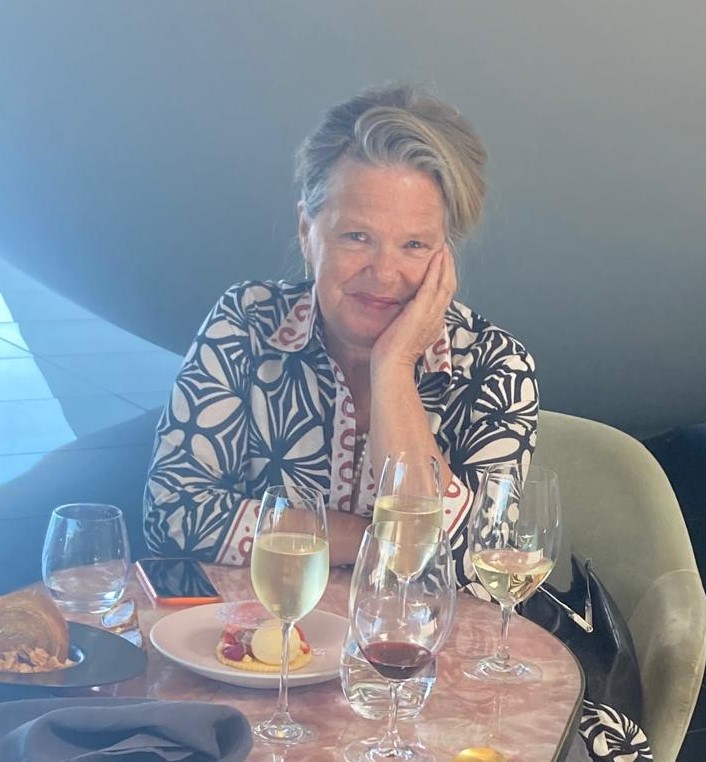
Jane Rankin-Reid is a Tasmanian based writer, foreign correspondent, editor, art curator and critic, published in The Guardian, Le Monde, Times of India and elsewhere in the UK, USA and Australia. Excerpts of her 1980s memoir The Colour of Night are published in WhiteHot Magazine NY, Cheerio, London and Brooklyn Rail.
 THE CITY KEY
I certainly won’t be toasting with water after the horror of the horse shoe , but clinking imaginary flutes of champagne to celebrate Jane’s writing
LikeLike