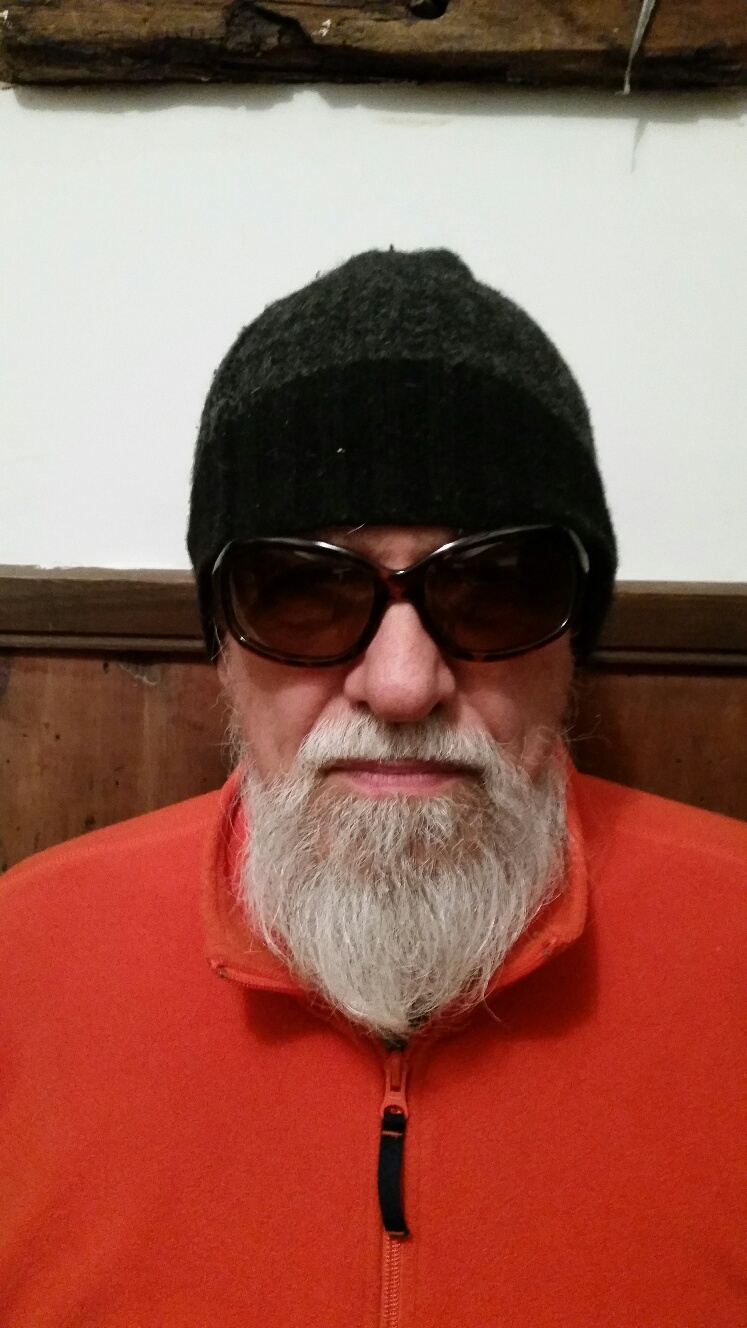
Two Poems by John Grey

On the Way to the Job

Another morning.
Traffic’s where I live.
It moves. It stops.
It stops some more.
Only traffic can freeze the scenery.
Only traffic can reduce the world
to the bumper stickers of the car in front,
the face of the driver
in the rear-view mirror.
Luckily, I’m going someplace
I do not wish to be.
This is my preferred speed.
It almost doesn’t get me there.

Morning in the Alley

Sunrise seizes on those
already with cheap gin on the tongue
like a slow, non-violent reflex action,
sets aside some shadow for the alley
but shines a thimbleful of light
on gray eyebrows, malted hair.
The world is busy elsewhere
but these men sit still
for whatever the sunshine brings,
everything patient about them
except their thirsts.
The day seeks out trembling lips.
shaking lingers.
a bottle passed around like gold,
a few cuss words
and an itching of the groin,
Dawn knows where to get a drink
at this time in the morning.

John Grey is an Australian poet and US resident. He was recently published in New Plains ReviewStillwater Review and Big Muddy Review with work upcoming in Louisiana ReviewColumbia College Literary Review, and Spoon River Poetry Review.

Please note: Poetry is compressed to fit smart phone screens. If you are reading this poem on a phone screen, please turn your screen sideways to make sure that you are seeing correct line breaks for this poem.

“Notre Dame” by Patrick Vitullo

Was its best face seen from
the Quai de la Tournelle,
Pont de L’Archeveche,
or Square Jean XXIII?
Whether the proboscis of facade
or the gothic grey body worded
and etched from the bookseller’s stalls
on the Quai de Montebello,
every look was different.
 
An arch of neck brought one up
its twin towers and shunned down 
the spouting gaff of gargoyles.
Its rose window bloomed before the Seine
while pigeons peripatetic gathered
en masse before a statue of Charlemagne.
 
A man bedecked in the
beauty of his language
asked for francs, a baguette,
and then, when none were offered, 
simply said, bonjour.
 
Like the countenance of its people,
that lean church beveled 
its spire to the sky.
As Emmanuel tolled
solemnly the moment when
Christ died, the Elysian arms of 
Our Lady buttressed 
the man’s tired hands.
And all Paris
foamed in the wake of a bateau-mouche.
 
Resized_20211102_114007

Patrick Vitullo is a writer, poet, essayist, and world traveler who lives in Havertown, PA. He was awarded the 1979 John T. Fredericks Prize in Literary Criticism by the University of Notre Dame where he graduated with a B.A. in liberal arts. He also has a law degree from Villanova University and limits his law practice to representation of injured workers. Patrick has been published in The Philadelphia Inquirer and The Antigonish Review. 

Please note: Poetry is compressed to fit smart phone screens. If you are reading this poem on a phone screen, please turn your screen sideways to make sure that you are seeing correct line breaks for this poem.

“Predications of the Municipal” by Colin James

Your wrecking ball smashed into
my theater’s old brick walls
past a surprised audience,
onward through the stage’s
painted canvass backdrop
releasing a cast of amateurs.
The Rimbaud posters
in the dimly lit dressing room
peeled at the edges.

Colin James has a couple of chapbooks of poetry published. Dreams Of The Really Annoying from Writing Knights Press and A Thoroughness Not Deprived of Absurdity from Piski’s Porch Press and a book of poems, Resisting Probability, from Sagging Meniscus Press.

Please note: Poetry is compressed to fit smart phone screens. If you are reading this poem on a phone screen, please turn your screen sideways to make sure that you are seeing correct line breaks for this poem.

“9/11” by Pete Mladinic

In Cather’s story, “Paul’s Case,”
after the coach rides, the baths,
the tortoise shell brushes, mirrors,
satin sheets, chandeliers,
plush carpets and ornate tables,
after the champagne and caviar feast,
Paul takes his baggage of flesh
draped in soft clothes
onto a final coach
into final woods, and down to the tracks,
and hurls himself into the path
of a locomotive,
choosing this form of death over poison,
pistol, or rope.  It seems
he wants nothing to remain of Paul,
wants Paul himself obliterated,
wiped clean from earth’s map,
no corpse, no likeness for mourners
to view and close the lid on,
and lower into an earthen hole.
Now, a hundred years after Cather’s Paul,
a father named Paul bids his family
goodbye,
not knowing it’s his final goodbye.
A farewell in the dark:  he leans
to kiss his wife’s cheek,
and then to the room of his sleeping son,
also Paul (an only child of an only child),
and leans and kisses his son’s brow
and, with light approaching from the east,
walks out his gate and leaves
his familiar street, not knowing
the finalities of these minutes
of September 2001, and to others
“on floor” when the plane crashes
through, and the sky falls
and turns into a celestial inferno.
Nothing left of September Paul
and those on his floor, nothing left
of the floor, or the shoes
he was wearing, or his teeth,
his wallet, nothing left there.
How could he have so much, one moment,
and then not even his teeth, his hair,
his family.  How different his case
from that of Cather’s brooding protagonist.

Pete

Peter Mladinic’s poems have recently appeared in Neologism, the Mark, the Magnolia Review, Ariel Chart, Bluepepper, and other online journals. He lives, with six dogs, in Hobbs, New Mexico. 9/11 originally appeared in Academy of the Heart and Mind.

Please note: Poetry is compressed to fit smart phone screens. If you are reading this poem on a phone screen, please turn your screen sideways to make sure that you are seeing correct line breaks for this poem.

“Lips Boudreaux” by James Knipp

The fat guy at the bus stop reminded Leonard of Tug Rooney.  He didn’t especially look like Tug.   The fat guy was tall and white and had the well-fed jowls and loud, bright voice of a suburban Rotarian, while Tug was short and gimpy with ashen skin and an asthmatic wheeze brought on by breathing decades of smoke.  It was more in the way they both could spin into a tale, the way the audience leaned in expectantly, especially the ladies, and how each always ended with a flourish, riding a wave of laughter through the finish.  Leonard had once asked Tug how he did it, how he commanded such attention. 

Tugs had put one hand on the back of Leonard’s neck and drew the younger man closer so he could smell the stale beer and cigar smoke that seeped from his pores.  He pointed at Leonard, the ever-present stub of cigar wedged between his fingers and said in his broken, sibilant croak, “Lips, you believe in what you say, people will follow, understand?”

Leonard, not quite a whisker past twenty at the time, didn’t, but he nodded all the same.  That was just how he was with Tug, when he asked, you nodded.  He had that way of making you agree.

The Rotarian at the bus stop finished his story and the ladies around him cackled laughter.  A bus growled up to the stop, belching diesel, and he strode away.  The ladies watched him leave with bird-like avidity, their eyes bright and admiring.

“He’s so nice,” one of them whispered.  The others nodded approvingly.

Continue reading “Lips Boudreaux” by James Knipp

Two Poems by Danny P. Barbare

The City of Charleston, SC

I like the old city. It fills me full
   of ghost.
How the horses still clop on the
   cobblestone.
A clipper ship floats in the harbor
   as if it has cross and bones
when the only lantern seems to
   be
   the moon
as steps draw nearer, between the
the shadows and the Spanish moss.

The City at Christmas (Greenville, SC)

These buildings are a little
   smaller
the sidewalks no longer run
nor the lights so many and
   magical
but I know they are there
somewhere in the
moonlight’s little coat.

Danny P. Barbare resides in the upstate of the Carolinas. His poems have recently appeared in Blue Unicorn and Ethel. And his poetry has been nominated for Best of Net by Assisi Online Journal. He has been published locally, nationally, and abroad.

Please note: Poetry is compressed to fit smart phone screens. If you are reading this poem on a phone screen, please turn your screen sideways to make sure that you are seeing correct line breaks for this poem.

“Man Sold Separately” by Danielle Keiko Eyer

It was one of those houses that had been dumped on the side of the street, meticulously equidistant from the houses on either side. It was one of those houses where the hot water never ran out in the winter and the air conditioner never broke down in the summer. The neighbours in the similarly-shaped houses shared gossip and borrowed cups of flour and pretended to like each other until the door closed and the lock clicked and their sincere thoughts came to light. It was a neighbourhood with the level of superficiality typically found in the suburbs.

Continue reading “Man Sold Separately” by Danielle Keiko Eyer

Three Poems by James Croal Jackson

Writing a Break-Up Album in the Underworld of Los Angeles

parking garage stone and yellow emergency
the microphone’s metal web against my lips

to vomit last year in haphazard dollops
of song, wolf, and waterfall dry music

career in loneliness this lifetime achievement
many-tailed and thick porous semiconscious

rambling strummed brown fingernails clacking
away at my hard reverbertion of longing the car

window closed to keep the sound in

Passing Claudia

in this city is a familiar intersection /
brick / unlike the old: stone / spotted
your doppelganger waiting the stoplight
/ stalled behind a truck and called your
name / as I drew closer / turned green
you waved back / could not halt my car’s
slope southbound after hello / goodbye
all acquaintances become ruins / friends
who shift faces / places to call home first /
my mother’s / my skeletal wandering to
belong / shell possessing consciousness
beneath acacias / humid summer of moss
between the cracks of historic buildings

in this city my heart is polluted

driving in circles everyone talks
about the same thing love weather
politics rain this summer gone
in a flood another day awash
in the lust pitter-pattering
off the black hot concrete
incalescent the days we
drive in circles around
each other, lip symbols
tiny trinkets the tiny purple
piggy bank I bought for you
from a quarter-slot machine
in a mall outside Youngstown

download

James Croal Jackson  (he/him) has a chapbook, The Frayed Edge of Memory (Writing Knights Press, 2017), and poems in Pacifica, Reservoir, and Rattle.

He edits The Mantle (themantlepoetry.com). Currently, he works in the film industry in Pittsburgh, PA. (jimjakk.com)

Please note: Poetry is compressed to fit smart phone screens. If you are reading this poem on a phone screen, please turn your screen sideways to make sure that you are seeing correct line breaks for this poem.

“Escalate” by Caroline Sipio

I.

The escalator pulls me above ground,
a maudlin monotony of movement
that cycles
tens
hundreds
thousands
of times a day.

I wait for the moment
the ridges of the moving stairwell
will halt the tips of my boots
so I can fall on my face.

What would it be like
to have strangers walk over me
or crack my spine like a book?

II.

The reel of you and me
runs through my thoughts
a faucet running on full strength,

relentless.

Are we filling the sink
or getting pulled down the drain?
Either/or
we’re drowning.

III.

Just
Beyond
The
Doors
I
Cannot
Reach

Words are written in black
against a yellow backdrop of caution paint:

WATCH THE GAP

The lettering is half-faded,
a mantra
that’s reinterpreted each day
to fit my mood, a horoscope
that I’m convinced will change my life.

csipio (1)

Caroline Sipio is a writer and bibliophile from the Philadelphia area with a penchant for coffee and imagining different arrangements of words. She has a Bachelors of Arts degree in English from Saint Joseph’s University and a Masters of Arts degree in English from Boston College. She has previously been published in Crimson & Gray. She currently works at Villanova University’s Falvey Memorial Library where you’ll find her happily surrounded by books. Caroline loves to celebrate Halloween year round and watch her miniature, wire-haired dachshund named Lemon play in the leaves.

Please note: Poetry is compressed to fit smart phone screens. If you are reading this poem on a phone screen, please turn your screen sideways to make sure that you are seeing correct line breaks for this poem.

Two poems by Jeff Nazzaro

Smiles

Needed a place to rest my bag,
had something to put in,
something else to take out.

Crowded Red Line train, stood
in the middle, one empty aisle seat,
beside an old woman

who slept, scarved head on the glass,
worldly possessions at her feet, on her lap.
Pilled blanket cradled slumped shoulders.

Blessed courtesy not to hog both seats,
she stirred when my bag touched down.
Unwelcome intruder, I worried.

I bent to put my phone in the special
padded phone pouch in my bag. Her
stirring roused the blanket, her clothes—

the odor hit me in the face like morning breath
from a generous lover. She turned her head, opened
her eyes, lifted them up, so close.

Still bent, I struggled to liberate my e-reader
from my bag’s special padded tablet pouch.
The first thing that old woman saw

when she unstuck her tired eyes
was my pale bespectacled face
and the smile I spread across it to greet her.

She smiled back, and it was warm,
and her eyes were open, bright, and big,
and then she pushed up her sleeves

and scratched and scratched the insides of her arms
up at the crook, first one, then the other,
etching lines of piqued white into the dark brown,

muttering about all those uncalled-for
things all those foregone people had said,
all the way to Pershing Square.

Post-Post-Post-Modern Poetry

I’m standing in the doorway
of the Metrolink train much
too early because this is the door
that opens right at the top of the stairs
that lead down into Union Station.

I’m much too early because the word
is out and this space fills up fast,
and if you wait too long in your comfy
blue polyester-and-Naugahyde seat
you’ll get stuck on the stairs behind
all the slowpokes and miss your next train.

I’m reading Alone and Not Alone,
by the poet Ron Padgett. See, I put my phone
away and took out the book, having borrowed
it a few days before from the university
library. The cover creaked open
with a virginal moan.

In between poems, my eye is drawn
to a middle-aged woman playing
some iteration of Candy Crush
on her phone. The colors mesmerize,
the action titillates, congratulatory
messages burst forth on the screen.

I look around and realize I am surrounded
by screen swipers and tappers, our poetry
being again rewritten, even as I put the Padgett
away and reach for my little black notebook
and ballpoint pen.

NazzaroPhoto

Jeff Nazzaro lives in Riverside and works in West LA. He commutes three hours each way using Southern California’s wonderful public transportation system and swears he loves every minute of it. His poetry has appeared in numerous print and online journals, including Ekphrastic Review, Cholla Needles Magazine, ClockwiseCat, and Thirteen Myna Birds.

Please note: Poetry is compressed to fit smart phone screens. If you are reading this poem on a phone screen, please turn your screen sideways to make sure that you are seeing correct line breaks for this poem.