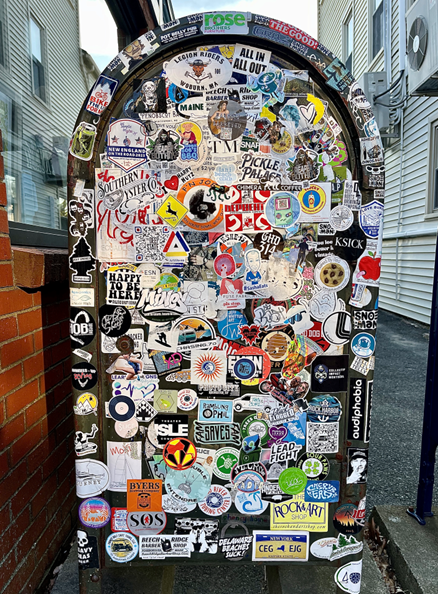
“Angle Town” by Hugh Findlay

Hugh Findlay’s writing and photography have been published worldwide. Nominated for a Pushcart Prize in 2020 for poetry, and the Best Microfiction Anthology 2024, he is in the third trimester of life and hopes y’all like his stuff. Instagram: @hughmanfindlay. Portfolio: https://hughmanfindlay.com
Three Poems by Ed Meek

Soundtrack of the City

The soundtrack of the city
can keep you up nights
or hum in the background
a discordant tune of wheels turning
and gears interlocking, trucks
unloading, planes taking off
and coming down.
The bass thumping in a passing
smoke-filled car. A Harley roaring
down the street. Sirens wailing
of rescues and D.O.A.
daytimes the volume
jumps to life with the birds
who serenade leaf blowers, lawn mowers,
horns, the ebb and flow
of traffic, the heavy breathing buses
the scraping skateboards,
barking dogs. The disembodied voices
of neighbors you’ll never know.

The Reserved Section

I’d wandered into the reserved section by mistake
but the performance had begun
and it was too late to escape
to the seats for the general public
my inexpensive ticket already paid for.
It was as if I had pulled back the curtain
and entered the first-class cabin–
been admitted to the club
and seated at the head table.
The champagne was vintage.
The caviar Russian.
The lights dimmed.
I was just behind
a Guggenheim and a Rockefeller.
They didn’t seem to see me.
I was invisible as I often am.
For once it was an advantage.
I glanced down the row at two
black women who smiled and nodded.

Hostages to Heat

In Brooklyn when the temp hits 90
the heat invades our claustrophobic co-op.
Outside, the cement sends the heat
up through our bodies in waves.
We float in our sweat like seals in the shallows.
I used to love the feel of sweat
blanketing my body
running in the mid-day sun
and playing pick-up basketball on black tar.
Now we dread summer days when
an orange disk occupies a hazy sky,
Particles of ash coat our lungs
and the sunlight sears our eyes.

Ed Meek is the author of four books of poetry and a collection of short stories. He has had work in The Sun, The Paris Review, Plume, The North American Review, The Boston Globe. He writes book reviews for The Arts Fuse. He is a contributing editor for The Rivanna Review. He teaches creative writing at the Osher Lifelong Learning Institute. He lives in Great Barrington with his wife Elizabeth and their labradoodle Mookie. His most recent book is High Tide.

“How to Survive Rain in Los Angeles” by Miro Myung

New moon in Aries, and the rain is pounding down on Los Ángeles. Patio furniture is tested throughout every neighborhood as parrots take shelter in the branches guarding us from high above. Love is a theme of this erotic moon phase–as well as the honking of car horns as the 110 South dangerously fills with standing water. Disjointed, disoriented, chaotic flow of the city that captures so many of our imaginations slowly molds you into its form: flexible jelly with a core of steel.

This is one of those days where it seems safer to just stay in bed. It sounds bad out there I think to myself as the beeswax candle cultivates a world of shadows on my bedroom walls. It’s 6:42am and the forecast is already set–scroll down and down, fall in and out of love with the bathroom mirror, cook dinner with your ex, play tug-of-war with your dog–do anything but open that front door.

But if you do have to leave, make sure to have water in your car in case you get sucked into a sinkhole on Sunset Boulevard and eat a healthy breakfast, but–no eight-hour fasting-whole-thirty kind of thing. Eat something hearty that gives your day a “leg up” or a “leg sideways” so that you can circumnavigate the loneliness of rain in Los Ángeles. The only certainty of today is that we will all have patio furniture that is going to be sixty-percent rot by summer and that our collective anxiety about the rain pounding that engineered Ikea wood will also hold us back from saving our four-legged friends from their fate. When it rains in Los Ángeles we live in denial–like when it’s 108 degrees Fahrenheit–we put a podcast on, throw some boy-brow gel on or whatever makeup makes you feel more ghastly and beautiful, and traverse through the city like it’s made for living.

To live in Los Ángeles is to be in love with the non-ending. Other cities might promise you solid conclusions–you know the neighborhoods well enough to predict the calm dinner out with the same friends, you know that people will complain about traffic and the influx of tech workers, you know that there will be no crowd spilling out of the neighborhood bar on a Tuesday night, you know that if you are lucky enough you will end well here in a way that will satisfy the order of things–a house, a career, a marriage, and even a golden retriever.

To live in Los Angeles is to be in love with the non-ending; a neighborhood bar is hard to locate because the highways keep beckoning you further and further into the tangled web of homes and palm trees and tiny restaurants bursting at their seams and linen-wearing humans picking herbs in Griffith and hidden farms in South Central twirling disco balls over colorful chickens and bowling alleys that sit along train tracks serving sukiyaki and cheese fries. This is a city of lonely transplants mixed impossibly with families who have lived here for generations and they clash in their cultures, but together, fall in love with the clean air after a steady rainfall.

On the highway is where I find my largest community–I used to think of myself as entering the herd, but now I see it as a convergence of “we’re all in this together” mentality and a “we are also very fucked” thought process. I love it. Does that make me abnormal? I’m not sure if Los Ángeles has a barometer for “normal” like smaller, more organized towns do. To be wacky, loud, disruptive, joyous, angry, and incredibly scared is to blend in here. If you’re not a little worried from time to time you’re not driving through the city enough.

Yet within the chaos are microcosms of sensual peace–Ethiopian jazz filtering through old speakers as lemon trees drip water onto terracotta tiles, smoke from chicken being barbecued in a grocery-store parking lot that captures your imagination, sunbeams melting over two-story level buildings in Koreatown, waves in Malibu tilting towards land boasting their dolphins, the clinking of glasses in old Hollywood steakhouses where the red velvet looks better in the dim light, spiraling labyrinths in Topanga Canyon where hikers hug the famous tree, mornings in your bedroom as you listen to the music of horns and rain and parrots and your neighbor chuckling to herself.


Miró Myung published articles in Tom Tom Magazine, a poem in Luna Collective Magazine, LA County Library’s “Love Letters in Light,” and co-published poetry book “Almanac of Tiny Clouds.” She does visuals for indie band Tangerine featured in NME, The Guardian, Rolling Stone India, Billboard with a BFA from UCLA.

“Temp Job” by James B. Nicola

Walk down Fifth Avenue for lunch hour when
you have a temp job in the Forties or
the Fifties; next day, do the walk again
and I’ll bet you a hundred to one you’re
not going to see any of the same
faces. I did this for about a year
when suddenly I thought I heard my name,
or something similar (I’m still not sure).

I turned and shook a total stranger’s hand.
He squeezed, I think, my upper elbow too
as if some mutual past permitted such
a thing. The passing gesture, so unplanned,
impressed me. I could not say where he knew
me from, but I shall not forget that touch.

James B. Nicola, a returning contributor, is the author of eight collections of poetry, the latest three being Fires of Heaven: Poems of Faith and Sense, Turns & Twists, and Natural Tendencies. His nonfiction book Playing the Audience: The Practical Actor’s Guide to Live Performance won a Choice magazine award.

Two Poems by Shontay Luna

Chicago (in the early ‘90s)

I. North Side – A Yuppie and Generation X
potluck constantly battling each other as they
sit between streeted throngs of decapitating
movie theaters, army surplus and fetish shops.
A full day’s shopping on Belmont from the Red
Line; two blocks from west to east you can get
a burger, tattoo, condoms, and a doughnut in all
in one swing. Baseball’s most disillusioned fans
in their red and blue regalia, herd themselves
bleary eyed with Pabst in hand four blocks
north of the urban jungle.

II. South Side – Baseball’s flip side, slightly more
civilized but still hungry~ Chinatown a world by itself
within another windy one. Walking down it’s on avenue
encompassing; like passing through an avenue of
time. Bronzeville used to be a glistening as it sounded;
the ensuing decades dulling it’s former polish. Former
middle class turned buppieville Chatham reigns further
south while Hyde Park gives off Greenwich Village
vibes while providing a landscape for a generation x
stomping ground to the east.

III. West Side – Mexico’s a Little Village and a modernized
time travel trip upon the twenty and the 6. Helplessly dotted with
year – round molasses ass traffic before disappearing into
the realms of Cicero and Berwyn. Beyond that, the Spindle
and the mall. Commercialism a beer belly in a too-tight shirt.
Northeast of that, urban poverty simmers and reeks while
suburban spectators cheer for the Bulls.

IV. East Side – Waltzes with Indiana’s frontier, hugging the
farthest curve of Lake Michigan. Beaches of rocky shores
and outlines of warehouses that billow smoke in the not too
far distance. Ten miles south of downtown, it once was an
area of factories: its hardworking streets lined with rows of
homeowners who worked at any of the five steel mills in
the area. Offering anything along Commercial Avenue
so as not be bothered with making the lengthy trip downtown.
For a taste of aged cornucopia, come to my home, Chicago.

Typical Chicago Weather

The gentle
branches
flutter in
the early
Autumn
breezes
traveling
in July.
Weaving
through
pavé glass
vases
embellished
in color
crepe squares,
jumbled into
pixelated
rainbows.

Chicagoan Shontay Luna is a poet, blogger and fanfiction author. Her work first appeared in Anthology and Capper’s and her most recent appearances include The Crucible, Press II Press and Blue Lake Review. Her newest book is ‘The Goddess Journal – a tool for unlocking the Goddess within every Woman.’

“Sailing to Sanctuary” by LindaAnn LoSchiavo

Please note: Poetry is compressed to fit smart phone screens. If you are reading this poem on a phone screen, please turn your screen sideways to make sure that you are seeing correct line breaks for the poem.

“Send these, the homeless, tempest-tost to me,
I lift my lamp beside the golden door!”  Emma Lazarus, 1883

What made them leave their native lands by boat?

Some heard fierce military thunder, saw
A blood moon rise in new duplicitous
Skies gone gunmetal gray, ruth camouflaged.

Some farmers ached from death’s cruel carpet ride,
Drought, famine, floods, the disintegration
Of dreams, all gone, one at a time.

Some faced more personal oppression: skin
Tone, birthright’s claims denied, religious foes,
Recognizing that falsehoods were designed
To dominate. Truth’s weapons were inert.

Some knew their powerlessness to outgrow
A humble past or lifelong poverty.

Approaching Ellis Island, side by side,
Examining our Lady Liberty,
Dropping an arm’s warm anchor happily
Around each other’s neck, they sense change
Is close along with assimilation — —
The circularity of homeland’s quest.

LindaAnn LoSchiavo: Native New Yorker. Elgin Award winner. Nominated for The Pushcart Prize, Best of the Net, Ippy, Firecracker, etc. Member: BFS, HWA, SFPA, Dramatists Guild. Recent titles: “Vampire Ventures,” “Apprenticed to the Night,” “Always Haunted: Hallowe’en Poems.”

https://VampireVenturesPoems.com
LindaAnn Literary: https://www.youtube.com/channel/UCHm1NZIlTZybLTFA44wwdfg

“Cairo at Dusk” by Fred Tudiver

Please note: Poetry is compressed to fit smart phone screens. If you are reading this poem on a phone screen, please turn your screen sideways to make sure that you are seeing correct line breaks for the poem.

The loudspeaker calling to sunset Maghrib prayer
carries through the sluice
of cardamom Cairo air
into the waterless, sandy dusk
filled with cars that speak their resolve.

I pray our ’82 Lada Zhiguli taxi
will make it to the hotel in Gezira,
memories of the last taxi ride break down
in Tahrir Square still fresh.

I can taste that pizza chased with iced karkadé tea
in Maison Thomas Pizza, under the flyover near the Marriott,
where the restaurant servers could not stop
touching Burt’s 3-year-old daughter’s blonde hair,
a shade they had never seen before.

After, we walk over to the hotel
and sip cold limones in the verdant garden bar
at the back.
Filled with stories.

Here’s the thing:
This poem is filled with vaporous nostalgia for
a Peace Corps style of working and living,
long forgotten by most.
Yet, perhaps this was my favorite life.

Fred Tudiver holds a BSc from McGill University, and an MD from Memorial University of Newfoundland. He is a new poet and likes to explore the human condition and the natural world. He has published in Black Moon magazine, Tennessee Voices Anthology, and the Canadian Medical Association Journal.

“Big Talk” by Mari de Armas

Whenever prompted, I provided my new address, followed by a forceful pronunciation of ATT-LANT-TAH. I said it this way to the movers, the insurance agent, and the post office until I heard my friend Lisa, an Atlantan herself, say, “Ahlannuh,” in one-and-a-half syllables.

We were catching up over drinks at a sandwich shop called Victory. Being new to the area, I asked her to pick the place and was a bit taken aback when she suggested it. I envisioned a Subway restaurant with a liquor license, but I was pleasantly proved wrong. It was a lively establishment with a smattering of booths and tables anchored by a busy bar. Two women with murals of ink tattooed on their arms bounced from table to table, taking orders and delivering mason jars of colorful drinks. Our beverages had just been delivered, mine a Victory Libre cleverly served in a glass Coke bottle, and hers a whiskey-coke slushy that made me wish I had a tolerance for Jack Daniels. Lisa, a writer, an amateur sailor, and a roller derby girl, could easily drink me under the table, so I was fairly certain that a few sips of her slushy weren’t enough to cause her to slur.

“Say it again,” I demanded.

“What? Ahlannuh?”

I had gone through this song and dance in Los Angeles already, running around town mispronouncing everything from street names to neighborhoods. I wasn’t about to make that mistake again, so I asked Lisa to listen and correct my pronunciation as I rattled off every landmark I could possibly remember from my guidebooks. She stopped me at the National Center for Civil and Human Rights.

“Everything is pronounced the same,” she said, waving her hand. “There are only three or four names that might be confusing.”

For those, she provided solutions apt to my maturity level. She explained that the first syllable in Piedmont Park is pee because you may need to do that in the bushes. The city of Decatur is pronounced ‘dick hater’ due to the prevalence of lesbians. Krog Market is not pronounced like Kroger Supermarket, but instead, it rhymes with hog because you go there to pig out. She said to resist the urge to pronounce anything in Spanish. Ponce ends in a silent ‘e’ like the word pounce. When Atlantans want you to pronounce the ‘e’, they add a ‘y’ to the spelling as evidenced in the name of a neighborhood called, Poncey-Highland.

I thanked her wholeheartedly for the lesson.

We were nearly done with our respective drinks when I asked the inevitable question former smokers raise when they’re out drinking and reminiscing: Do you have? and then put two fingers up to my lips because uttering the word cigarette is too disgusting.

She didn’t have any, but I wasn’t too disappointed. It was a long shot. I mean, who smokes anymore?

“Let’s go outside and see if anyone has an extra cigarette,” she said, already standing.

Her plan sounded ludicrous. In Los Angeles, the closest smoker you’d find was in Nevada.

“Should we tell our waitress that we’ll be right back?” I asked, certain that I was going to get hip-checked by present-day Rosie the Riveter for walking out on my tab.

Lisa waved me off again.

Miraculously, we found not one but several smokers of the nicotine type.

“I hate to ask,” Lisa announced, and before she finished her question, a young woman with sunglasses propped on her head heeded the call.

“Camels okay?” she said, holding open her pack for Lisa to pilfer.

“Do you need one too?” she asked me.

“Oh, no, thank you,” I said, falling over myself. “We’ll share,” I suggested humbly.

“Don’t be silly,” she said, holding out her box for me.

“I’ve got Parliaments, if you prefer,” a man’s voice boomed from the corner.

I gasped. That was my brand. And like a child being lured into the back of a van, I walked right over to him.

I was really out here bumming cigarettes like it was the late nineties.

His cigarette hung from his lips precariously over his lengthy beard as he lit mine. Before I could say thank you, I was somehow swept into a conversation. Sure, smoking is a social activity where chit-chat is exchanged between participants. Someone mentions the weather, and the other person replies in agreement. Then, the replier is compelled to say something else to not make the person who initiated the conversation feel bad about breaking the ice. You know, your standard, textbook small talk. But this was not that. If anything, this was big talk.

“Y’all know these two parking lots have different prices, and they’re right across from each other, right?” he said.

“Yeah. That lot is a rip-off,” Lisa said.

“Seriously? That’s where I parked.”

“That’s the most expensive lot in all of Decatur,” he said, pronouncing it the way a lesbian would.

“She just moved here,” Lisa said in defense of my ignorance.

“Well, that’s a tough first lesson to learn,” he said before taking a drag.

“Where’d you move here from?” asked the Camel smoker.

“L.A.,” I said, thinking that would suffice, but all it did was spark up a conversation about me that didn’t really include me.

Guy with the Parliaments: “It’s so expensive out there…”

Girl with the Camels: “And so many people are moving over here…”

Guy with the Parliaments talking about me when I’m standing right there: “She’s probably with the movie business…”

Girl with the Camels: “Did you rent or buy a place? Well, it doesn’t matter, really. It’s really driving prices up…”

The door of the establishment flung open, and our waitress appeared. Oh, here we go, I thought, bracing for the tackle.

“Another round?” she hollered.

Lisa and I responded in the affirmative.

“Should I buy these people drinks,” I said, pointing at our cigarette benefactors.

“No, that’s creepy,” she said.

That’s creepy? These people knew more about my life in two minutes than my blood relatives had in three decades. I shrugged my shoulders and took slow, methodical drags, enjoying what remained of my taboo habit and making note of the lessons learned.

There were other curiosities that Lisa left out in my orientation. For example, Atlanta’s elevator problem. I suppose it wasn’t a purposeful omission but one that has to be experienced. The first time it happened to me, I was sharing an elevator with a group of overly polite men who, upon the doors parting to reveal our floor, turned into adorable toy soldiers. They performed a choreographed about-face to allow me to egress, even though I was standing in the back corner. I didn’t understand what was happening until one of the men extended his hand outward to usher me out.

“Oh, gosh, thank you,” I gushed like a fourth runner-up at a beauty pageant.

Half a dozen more of these exhibitions of impractical chivalry later, and I was ready to lobby for gender-neutral elevators. I got into a few ‘you first, no you first’ bouts and when my outfits bordered on androgynous, it created a lot of consternation. I could see the machinations behind their eyes. They were horrified to offend me but more scared to dishonor their mothers, who made them promise to always let the lady go first. More than once, I missed my exit because men couldn’t create a pathway fast enough to beat out the doors. I started to add an extra five minutes to my commute if I knew the location of my appointment was taller than a two-story building. An effort that meant nothing, as time is arbitrary here. Another interesting aberration.

Every city has its own tempo and Atlanta’s hovers in the realm of Jazzy Muzak. Citizens butterfly around like a lovely alto sax solo without urgency to make it to where they need to be. Why would they? Dinner can be ordered at 3 a.m. and breakfast at 3 p.m. You can watch exotic dancers perform in darkened rooms when it’s broad daylight outside and play carnival games under the stars on the roof of the old Sears building.

There are only two things, and two things alone, that you can count on being on time. The first is 5 o’clock rush hour, and the second is lesbian kickball games. Equally intense, both feature moments of elevated frustration, immense fear and tons of drama, but neither is ever tardy.

When I realized this phenomenon, I made an effort to be late to social gatherings, but as hard as I tried, I was always the first to arrive. On one particular evening, our group had 7:15 p.m. reservations at a Midtown Mexican restaurant called Zocalo. Restaurant is generous. It’s really an open deck shack without doors or windows that looks like it was transported directly from the sands of Acapulco onto the pavement of Piedmont Avenue. I arrived twenty minutes late, and even the hostess was surprised to see me.

“We don’t have your table ready just yet,” the hostess said, looking down at a sheet of paper.

“No worries,” I said, completely worried. “I’ll be at the bar.”

“Ok, I’ll come get you when it’s ready,” she said, fully knowing she wasn’t going to remember to get me.

This was not an ideal situation because it was a busy bar, and in order to keep my seat, I was going to have to order and re-order until my friends arrived. There’s nothing more unpleasant than being the first one of the group to get drunk, especially when there’s no group. I didn’t want to be out of sync with everyone else because I hit the pre-game too hard, so I decided my stop-gap measure to avoid this problem was to order beer. I figured I could have one or two and still maintain my composure.

I sipped slowly and lifted my gaze to people-watch. The demographics of the patrons skewed more than a decade younger than me. They were so beautiful, without laugh lines or wrinkled foreheads. Drinking salted-brimmed margaritas and baskets upon baskets of chips and salsa without worry of acid reflux. To be twenty-something again. I would be doing shots of marinara sauce and snorting lines of collagen in the bathroom.

“Hey Mari!” I heard a man’s voice say.

I searched the room, but no one was looking in my direction. If someone said ‘Mari’ in a crowded Miami bar, 17 women would activate like a Sims character, but hearing it in Atlanta was remarkable. Not to mention pronounced correctly. None of this Maury bullshit that I had to contend with in Los Angeles. It was a proper Mari with a rolled R. Through the cluster of people squeezed into this tiny space. I saw a man embracing the presumed Mari. She was petite with long, dark brown hair. Latina, from what I can see. My bartender and her black lipstick snapped me out of my rubbernecking.

“Another one?” she asked. I smiled nervously and looked at my phone riddled with texts that claimed things like ‘almost there’ and ‘in the Uber’ and ‘traffic is bad’.

“Yes, please,” I answered.

While she fished out my second beer, I once again turned my attention to my namesake to see a smartly dressed young woman with short, blondish hair trying to get Mari’s attention.

“Hi! I’m sorry to interrupt. I hope you don’t think this is weird. Is your name Mari?”

I gasped in ecstasy at the thought this was going to be one of those ‘that’s my man you’re with’ situations. I turned back to grin at the bartender as she placed the bottle on a coaster and went right back to eavesdropping.

“Yeah,” Mari answered cautiously.

I positioned myself to get a better view of this soon-to-be dinner and a show.

“This is crazy. My name is Mari, too,” the second Mari said excitedly.

I nearly spit out my beer.

“Wait. How do you spell it?” the first Mari asked the other.

“M-A-R-I” answered number two.

“Oh my God, me too!” They both squealed.

Was I being punked? I looked around for hidden cameras.

“I heard someone say my name,” number two continued, “And I looked up to see your friend, but I was like, I don’t know that guy!”

“This is my friend Brian,” number one said, now bringing in the guy that sparked this Abbott and Costello routine.

I sat fascinated. As members of their respective parties arrived, they repeated their meet-cute story; all the while,
I sat quietly, debating whether or not to say something.

“I’m over here waiting for you to get here, and I heard someone say my name, but it wasn’t you,” Mari said to a friend who had just arrived. And then the first Mari added, “It’s spelled the same and everything,” to the person listening.

After the third rendition, I was done being an observer. I mean, how could I not insert myself into this story? I drowned the voice telling me to stay out of it with a few more gulps and then took the plunge.
“You guys are not going to believe this,” I yelled across the bar. “My name is Mari too.”

From the commotion we caused, the diners in the main room must have thought someone dumped a bag full of hundred-dollar bills on the bar. We clustered together in one corner, and, like good Atlantans, we engaged in “big talk.”
One of the Maris shared that she was adopted, the other one invited us to do bumps in the bathroom, and I confessed that when someone calls me Maria, I fantasize about murdering them. You know, casual.

Somewhere between the first and second tequila shots, it dawned on me that, well, that I was very drunk, but most importantly that the reason Atlantans chat so much wasn’t that they’re extra talkative, but it’s that they’re bored from waiting for their friends to show. Maybe those smokers back at Victory were so happy to share their cigarettes and their opinions because they had mistakenly arrived too early.

“Where are your friends?” Mari number two asked me, with her arm around my neck.

“I think they are stuck in an elevator going after you, no after you.”

The Maris knew exactly what I meant, and I had never been more seen.

Mari de Armas was the first of her family not to hail from the island of Cuba. She is a content strategist for a glitzy client list of cruise lines and hotels and blogs at ALittleCubanGoesALongWay.com. She holds a Bachelor’s in English and resides near Washington, DC, with her wife.

Two Poems by Richard Collins

Please note: Poetry is compressed to fit smart phone screens. If you are reading this poem on a phone screen, please turn your screen sideways to make sure that you are seeing correct line breaks for the poem.

UNCLE HARLAN

I always loved when Uncle Harlan came to visit
Not often but when he did I didn’t miss it

He was what I didn’t know existed
Something our women called sophisticated

Back again from Europe he treated us
To a slideshow: Madrid, London, Paris

He wasn’t an uncle really of course
But some distant cousin, third or fourth

Handsome Uncle Harlan had style and taste
All the women whispered it was such a waste

That he was a (quote/unquote) Confirmed Bachelor
Which meant in those days he either played the women

Or played the woman to other men. I didn’t care
He was tall and angular, long neck and slick black hair

Peppered his speech with French and Spanish phrases
Failed to teach me not tongues but how to tie my shoes

I tie them still with clumsy loops like cowboy lassoes
That elicit laughter, so I switched to loafers like his

Soft Italian leather like skin to touch
Buffed to perfection, that is: not too much

He didn’t want to be tied down. Convention kills
He confided. His European souvenirs were personal

Secrets to be savored, not shared as public art
But hidden in the hollow camera of the heart

To this kid, it was no one’s business what he did
He’d been to Paris, London and Madrid.

SACRED CITIES AND PROFANE

Tlachihualtepetl

From the Garden of Edinburgh
Back to the city of brotherly love

A taxi stuck in snow in Swansea
Never reaches London, much less Copenhagen

A train breaks down at Saint Pancras Station
Canceled pilgrimage to Canterbury

A blushing romance in Bath
A surrender, a seduction, a velvet rejection

Legs remembered and streets forgotten
Amsterdam, Paris, Brussels, the Hague.

***

A plane lands clumsy as an Albatross
On a hijacked Grecian runway

For a honeymoon in Cretan caves
Pink and black Santorini sand

Worship in the bay of Kythera
Deep bows to terraced Sifnos vines

Tours and detours of Istanbul
Drowned nudes in underground cisterns

Selçuk’s Cavern of the Seven Sleepers
The sickness not quite unto Ephesus

Then back to mathematical Samos
And the legends of long-legged Lesbos

That was one life; this is another
In no particular order.

***

Driven to city after profane city
Touching down in Sofia, Timișoara

Far from naked rocks in the sea
Corinth and Thessaloniki

To Budapest and Bucharest
Cities asleep without rest

This is one life; that was another
Mixed like a cocktail with bitters and ice.

***

What about the car wreck on River Road
What about the pool cue sold

And what about the train wreck on the way from Trieste
To Belgrade, the engineer spatchcocked on a flatcar

On the very day that protesters in Tiananmen Square
Faced down tanks, next morning headlines in Athens told us.

***

Fact is, I died long before that in the City of Angels’
Valley of Slow Death, ascended in a Delta jet

Looked out over the panorama of my youth
Dry sands of Cucamonga to muddy waters of Pacoima

From the islands of Balboa to the beaches of Laguna
A trip to Venice for the price of a pawned guitar

Stolen kisses, kitsch and country music cliches
Marriages and mockeries and blood-soaked clouds

Tumbled down at last dead drunk and lost
In the haze of Ciudad de México, then Puebla

Long before the more fortunate infidelities of the fall
Resurrection an empty promise, or threat.

Richard Collins has lived in Eugene and Baton Rouge, Bucharest and Timisoara, Los Angeles and London, Swansea and now in Sewanee, Tennessee. His recent work has appeared in The Plenitudes, Willows Wept, and Marrow. A memoir, In Search of the Hermaphrodite, is out from Tough Poets Press (2024).

Two Poems by Ryan Harper

Please note: Poetry is compressed to fit smart phone screens. If you are reading this poem on a phone screen, please turn your screen sideways to make sure that you are seeing correct line breaks for the poem.

Flight Path, St. Louis

Stressed skin—we were in descent—
there is only guessing westward
until the islands, the confluence,
the slant waters begin to tell true.

We have known Missouri by the props
and seams: levees, bottoms,
struts and stays of the highways
in crossing, headstones of Calvary
and Bellefontaine growing

on approach. We are knowing ourselves
as the great arch sways, close
quarters and wind-swung, teasing
expansive glances through small
frames—catenary upended, still
and ever bearing fantastic weight

in the base sectors. We course down
into Missouri, heavy in the current
that holds, resists our passage—
a landing just downstream from the last
great union until Cairo, Defiance,
all things between us arch
and flatter, a hyperbolic function.

Hudson Yards

Clear and Roman
the tug mid-river,
anchored with its cargo,
awaiting this day
its orders, its holdings low.

And the day arrives
in mute pangs of fire,
exacting dawn distending
between the ribs of the city
against the far shore—

the glass, the gathering flow,
the sun-drowsy vessels
clear for passage, holding
bleached economies
in freighted light.

Ryan Harper is an Assistant Professor of the Practice at Fairfield University-Bellarmine in Bridgeport, Connecticut. He is the author of My Beloved Had a Vineyard (Poetry Press of Press Americana, 2018). Ryan is the creative arts editor of American Religion Journal and lives in Bridgeport, Connecticut.