“Empty Venue/Full House” by Linda Romanowski

Performance played to an empty hall
live audience deprived they played on,
our lives depended on it.

The question begged of Orchestral performance,
who would hear their sound in an empty venue?
Their Facebook page unleashed a virus of its own
virtual seating unlimited, Livestream untethered.
The Fifth and Sixth symphonies of Beethoven,
the Fifth called “Fate,” four notes that changed the world.
They say those prime first notes came from bird’s singing
while Ludwig van inhabited Deaf’s door.

No time to lose, musicians dispatched mastery,
bound to inject perfection to its core
their bodies concentrated, driven, focused
to bring that bastard, Covid, to its knees.
At the Fifth, 4th movement, Livestream comments
exploded upward, hidden keyboards volleyed.

Multitudes heard the silver lining of sound.

The rushing notes as cells divided fast
beat that sucker to its knees,
bowed heads to Beethoven’s 5:4,
they played that most beloved, breathing gem,
played like penicillin bows, strings, elbows gliding,
brass kicked ass, feet stomped, pedals struck timpani,
racing, throbbing veins pounding an enemy.
Fingers smiled, pulled the trigger, rushing notes pulsing
thunder through the bloodstream, headed for each
tip of Covid’s crown.

Relentless notes, the antigen, music antibody gone viral-
Beethoven vaccine, set to vanquish the Invader.

Thousands of Yannicks conducted, fencing cell demons
to their jugulars, punched air in time to thwart destruction
chapped washed hands listened,
slammed favorite air instruments
pounded surfaces in kitchens, dens, cars.

Upraised thumbs, floating fireworks, streamed up screen,
signs of relief, healing, momentary pause
encores of hearts and bravos soared.

The most moving of all movements
no movements at all,
when the Philadelphia orchestra stood and faced
their empty venue hall.

Linda Romanowski, a resident of Ardmore, Pennsylvania, traces her roots to South and Northwest Philadelphia. Linda obtained her BA from Rosemont in Psychology and Elementary Education. She is currently enrolled in Rosemont’s MFA Creative Non-Fiction Program. Her primary focus is portraying her Italian heritage experience.

Since 2017, Linda has served as a reviewer for “Rathalla” magazine. Her essay, “Pot It’s Not,” was published in City Key in 2018. This year, she is a poetry reviewer for “Philadelphia Stories” for the Sandy Crimmins National Poetry Prize.

In 2019, Linda and her husband, Ken, participated in the Rosemont College Global Studies Program at the Sant’ Anna Institute in Sorrento, Italy. Her blog appeared on Rosemont’s Facebook page and was published in RoCo, Rosemont’s online publication.

In 2015, Linda received the Bonnie Hilferty Freney ’64 Memorial Award for volunteer service to Rosemont and currently serves as president of the college’s alumni board.

Please note: Poetry is compressed to fit smart phone screens. If you are reading this poem on a phone screen, please turn your screen sideways to make sure that you are seeing correct line breaks for this poem.

“Carrol Avenue” by Joshua Ginsberg

You never promised
to make me a writer or an artist;
only that you would beat me like one –
backbreaking barbacking
reeking of beer and dragging ass home
just in time to curse the sunrise;
you hardened me to the clatter of the L,
showed me who serves
the best Chicken Vesuvio,
taught me to drink bourbon neat, and
where to find a stone mermaid
carved by the shore of Lake Michigan.
Whispered to me all the dirty things
you never told Sandburg.
On days so cold I thought I might shatter
you slid a warm sly smile into my pocket
waiting for a cab at Chicago and Milwaukee
while I read the inscription at the base
of Nelson Algren Fountain.
You lowered me down below the streets,
entombed so deep under
prairie style terracotta and concrete
that sunlight’s just a myth, where
you stole my teeth and wallet, left me
drained and dreaming, straining in the dark
to see through two bruised and swollen slits;

but it was there in the shadow of the bricks
of that rat’s nest palace of filth,
that at last you spread wide
your tarnished gold wings
and blessed me with
your secret face.

Joshua Ginsberg is a writer, entrepreneur, and curiosity seeker who relocated from Chicago to Tampa Bay in 2016. He is the author of “Secret Tampa Bay: A Guide to the Weird, Wonderful and Obscure,” (Reedy Press, 2020), and his poetry, fiction, and non-fiction has appeared in various print and digital publications. He maintains a blog, Terra Incognita Americanus and has been a business proposal and resume writer for over 10 years. He currently resides in Tampa’s Town and Country neighborhood with his wife, Jen, and their Shih Tzu, Tinker Bell.

Please note: Poetry is compressed to fit smart phone screens. If you are reading this poem on a phone screen, please turn your screen sideways to make sure that you are seeing correct line breaks for this poem.

“Swimming in Montevideo” by Steve Carr

Swimming, my arms slice through the water, one arm, and then the next. Over and over. My fingers are held firmly together, and pointed, like the head of a spear. My shoulders swivel from side to side, twisting my torso. My muscles are like pulled taffy, pliable, twisting, elastic. A continuous flow of power – an electric current of physical, bodily, energy – courses through my legs. They are scissors cutting the water. My feet are fins, paddles, webbed-like, kicking and churning up the water, leaving a continuous splashed trail of bubbles in my wake. The water is cool. It slides over the smoothness of my flesh. I shed it like ever-changing layers of liquid skin.

Continue reading “Swimming in Montevideo” by Steve Carr

“Man Sold Separately” by Danielle Keiko Eyer

It was one of those houses that had been dumped on the side of the street, meticulously equidistant from the houses on either side. It was one of those houses where the hot water never ran out in the winter and the air conditioner never broke down in the summer. The neighbours in the similarly-shaped houses shared gossip and borrowed cups of flour and pretended to like each other until the door closed and the lock clicked and their sincere thoughts came to light. It was a neighbourhood with the level of superficiality typically found in the suburbs.

Continue reading “Man Sold Separately” by Danielle Keiko Eyer

Three Poems by James Croal Jackson

Writing a Break-Up Album in the Underworld of Los Angeles

parking garage stone and yellow emergency
the microphone’s metal web against my lips

to vomit last year in haphazard dollops
of song, wolf, and waterfall dry music

career in loneliness this lifetime achievement
many-tailed and thick porous semiconscious

rambling strummed brown fingernails clacking
away at my hard reverbertion of longing the car

window closed to keep the sound in

Passing Claudia

in this city is a familiar intersection /
brick / unlike the old: stone / spotted
your doppelganger waiting the stoplight
/ stalled behind a truck and called your
name / as I drew closer / turned green
you waved back / could not halt my car’s
slope southbound after hello / goodbye
all acquaintances become ruins / friends
who shift faces / places to call home first /
my mother’s / my skeletal wandering to
belong / shell possessing consciousness
beneath acacias / humid summer of moss
between the cracks of historic buildings

in this city my heart is polluted

driving in circles everyone talks
about the same thing love weather
politics rain this summer gone
in a flood another day awash
in the lust pitter-pattering
off the black hot concrete
incalescent the days we
drive in circles around
each other, lip symbols
tiny trinkets the tiny purple
piggy bank I bought for you
from a quarter-slot machine
in a mall outside Youngstown

download

James Croal Jackson  (he/him) has a chapbook, The Frayed Edge of Memory (Writing Knights Press, 2017), and poems in Pacifica, Reservoir, and Rattle.

He edits The Mantle (themantlepoetry.com). Currently, he works in the film industry in Pittsburgh, PA. (jimjakk.com)

Please note: Poetry is compressed to fit smart phone screens. If you are reading this poem on a phone screen, please turn your screen sideways to make sure that you are seeing correct line breaks for this poem.

Leaving the City by Shaun Haughey

A train of thought still connects me to the city

but I never reloaded my card to go back.
Instead, I left tall buildings,
letting them continue to pulse
and breathe and mingle at their block party.
I left the music of street performers,
the dancing legs of drunks in bars
and brilliant lights shining down from stars.

The stars faded,
dissolving into ribboned stories
cut apart by speeding cars.

Now, I sit slumped in my suburban chair
only moving to pull the blinds shut.
Here, in my room,
where acrylics dry quickly,
I no longer taste the toxic mixture
of turpentine and hair.

Here, I remain living a quiet, quaint life
and when I peak out the window to see
the city still beckoning in the distance

I want to go back there…

Shaun Photo

Shaun Haughey is an artist and writer from South Jersey. In 2017, he received his Bachelors of Fine Arts and Minor in Art History from Rowan University. While he attended Rowan, he was a proud member of the printmaking club. He also served as part of the editing staff at The Gallery. His work has appeared on a number of posters throughout the Philadelphia area for bands and events such as Circle of Hope, The NJ Proghouse, and The Tea Club. In his work, he explores mysterious anomalies to make sense of reality. Though he still doesn’t, he hopes that by delving into the mysterious, he can avoid an existential crisis. When Shaun Haughey isn’t ruminating on the meaning of life, he enjoys spending time with his family, reading comic books, listening to music way too loud, getting absorbed in video games, and flying in his TARDIS. You can follow his work on Instagram @shaun.hoy

Please note: Poetry is compressed to fit smart phone screens. If you are reading this poem on a phone screen, please turn your screen sideways to make sure that you are seeing correct line breaks for this poem.
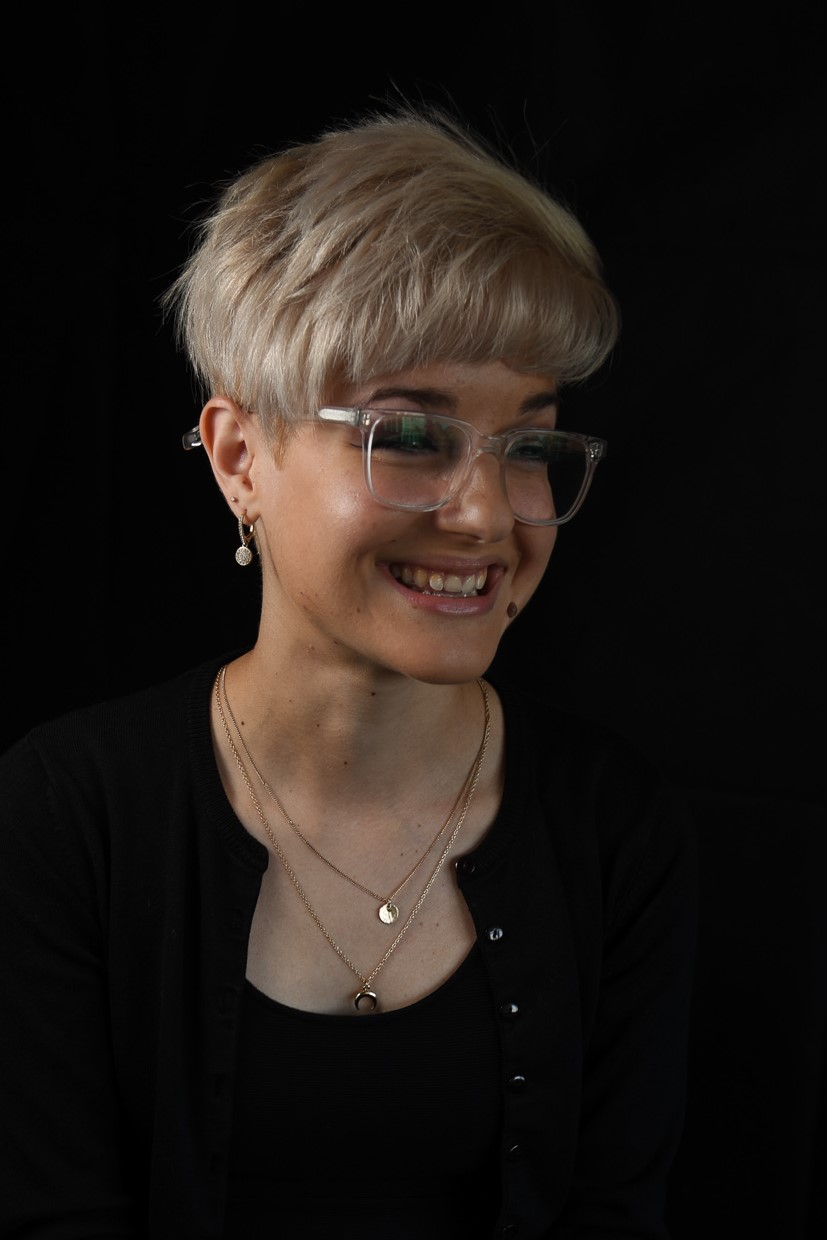
“Escalate” by Caroline Sipio

I.

The escalator pulls me above ground,
a maudlin monotony of movement
that cycles
tens
hundreds
thousands
of times a day.

I wait for the moment
the ridges of the moving stairwell
will halt the tips of my boots
so I can fall on my face.

What would it be like
to have strangers walk over me
or crack my spine like a book?

II.

The reel of you and me
runs through my thoughts
a faucet running on full strength,

relentless.

Are we filling the sink
or getting pulled down the drain?
Either/or
we’re drowning.

III.

Just
Beyond
The
Doors
I
Cannot
Reach

Words are written in black
against a yellow backdrop of caution paint:

WATCH THE GAP

The lettering is half-faded,
a mantra
that’s reinterpreted each day
to fit my mood, a horoscope
that I’m convinced will change my life.

csipio (1)

Caroline Sipio is a writer and bibliophile from the Philadelphia area with a penchant for coffee and imagining different arrangements of words. She has a Bachelors of Arts degree in English from Saint Joseph’s University and a Masters of Arts degree in English from Boston College. She has previously been published in Crimson & Gray. She currently works at Villanova University’s Falvey Memorial Library where you’ll find her happily surrounded by books. Caroline loves to celebrate Halloween year round and watch her miniature, wire-haired dachshund named Lemon play in the leaves.

Please note: Poetry is compressed to fit smart phone screens. If you are reading this poem on a phone screen, please turn your screen sideways to make sure that you are seeing correct line breaks for this poem.

Two Poems by Diane Grosse

Somnolent on the 1374

Floating bodiless over
a spectacle of color
crowds in harlequin regalia-
exaggerated bodies with
noses casting shadows
three feet long-
grotesque faces emit deep laughter.
The mind dances with sequined
guests as we glide on tiny smooth wheels
rolling through

a breezy meadow with
fluttering bouquets of butterflies.
Run and tumble, arms feathering
through multicolored daisies-
giggles catching in wispy fine hair

at a place of work
a familiar feel of tension-
the looming figure snatches
pages spitting from the printing mouth
waiting for approval.
Crinkles snake across
their forehead

Fordham
This is the local train to Stamford.
shift awake-

Tickets please.
force the ungluing
of eyes to produce the ticket
for a conductor
holding a slender cream baton
keeping time
gliding metal
starched white gloves
in flawless motion-
a kettle drum reverberation
lull

Days Before Winter Solstice

Shuffling office papers thirty feet up with windows
nailed shut for your safety, a barely traceable
scent of food turns a head, eyes settling past traffic lanes.
The bar’s picnic tables are un-hibernated, as are its patrons,
taking advantage of this seasonal mixup.
College gals lean forward, spilling out among themselves
(plus one); Overloaded straps about to ping.
Finger-combed hair is pulled back and
high in unison, piling to top knots –
All alike dolls.
Pitchers dribble. The girls follow,
washing down the gold.

Diane Grosse has been writing since childhood – spilling memories, desires, and fantasies onto paper. She has spent her professional life in the publishing industry, surrounded by words. After receiving a Masters in Writing, she upended her life, leaving her beloved New York for the South – and new sources of inspiration. Her first publication and award was for the poem, translated to Spanish as El Trovador, durng high school. Her writing has been published sporadically over the years in journals and newspapers. Most recently, her poetry was published at naturewriting.com, and an essay has been accepted for inclusion in a collection of works on the topic of human/animal interactions, forthcoming.

Please note: Poetry is compressed to fit smart phone screens. If you are reading this poem on a phone screen, please turn your screen sideways to make sure that you are seeing correct line breaks for this poem.

“Bus Station” by Eileen Moeller

You:
Mister Bulgy Hair Rasta Man

and You:
Miss Spike Heels short skirt geography tights

and You:
School Uniform Knee sock Girls whispering about school
uniform boys passing by

and You:
Mister White Hair Highland Fling braid down the back

and You:
Mister Prep School Tie and pinstripe attache case

and You:
Mrs. Old Lady like a dumpling

and You:
Mrs. Sleek Chanel gold chain and button everywhere sheer
stocking alligator handbag

and You:
Mister Buzz-cut Leather Jacket Pirate earring tooth gap football fan

NONE OF YOU EVER
NONE OF YOU
NONE OF YOU

NONE OF YOU
EVER WILL

GET INTO A POEM OF MINE

UNLESS I WANT YOU TO

AND DON’T YOU FORGET IT.

Photo 35

Eileen Moeller and her husband, Charlie, have lived in the Philadelphia area for the last twelve years. She has two books: Firefly, Brightly Burning, published in 2015 by Grayson Books, and The Girls in Their Iron Shoes, published in 2016 by Finishing Line Press, and has many poems in literary journals and anthologies. Her blog: And So I Sing: Poems and Iconography, is at http://eileenmoeller.blogspot.com

Please note: Poetry is compressed to fit smart phone screens. If you are reading this poem on a phone screen, please turn your screen sideways to make sure that you are seeing correct line breaks for this poem.

“London: Circle Line” by Eileen Moeller

A woman reads on the Underground
as it drags like a match along the tracks.

A woman wearing a handkerchief linen blouse
on the hot train reads a thick book
about World War II and bites her lip.
A young girl stares at her as she does this.

A girl who sits on her suitcase at the car’s end
with nothing to do but stare at the woman’s
head as it tilts toward the book,
her blunt cut hair, the drama of her face
as it acts out the words.

The words unknown, of course, to the girl,
except for what she can see in the angle of brows,
the pinch of lips, lashes flickering
the way signal lights
pull a train along
beneath the pages of city above.

Images float to those hungry for them.
That’s what they say
and that’s why some angle off
to an old lady at the other end.

A white haired lady frail in her thick coat,
in spite of the heat, who glances full of longing
at the blonde hair of the girl
squinting past her down the car.

This is how it works and always has, just like a fax.
Heat transforming text into text
and the certainty of response:

mysterious as the memory of a young girl’s
first awakenings to the world
as she hunches in silence with strangers
under the ground while London burns.

Photo 35

Eileen Moeller and her husband, Charlie, have lived in the Philadelphia area for the last twelve years. She has two books: Firefly, Brightly Burning, published in 2015 by Grayson Books, and The Girls in Their Iron Shoes, published in 2016 by Finishing Line Press, and has many poems in literary journals and anthologies. Her blog: And So I Sing: Poems and Iconography, is at http://eileenmoeller.blogspot.com


Please note: Poetry is compressed to fit smart phone screens. If you are reading this poem on a phone screen, please turn your screen sideways to make sure that you are seeing correct line breaks for this poem.